Diagnostics & Electrical Repair in Blair, Nebraska for Check Engine Lights, No-Starts, and Electrical Faults
A check engine light, no-start condition, power loss, electrical fault, or warning code should not turn into a parts-throwing guessing game. STS Truck Services helps fleets and owner-operators find the real cause before a small issue becomes bigger downtime, repeat repairs, and a much more expensive breakdown.
The goal is simple: diagnose with proof, explain the repair clearly, and help you make the right decision before the truck costs you more time and money.
Why Diagnostics Matter
- Find the real issue before replacing parts
- Protect uptime and reduce repeat repairs
- Avoid turning a warning light into a breakdown
- Make repair decisions with proof, not guesswork
Good Diagnostics Protect You From Expensive Guesswork
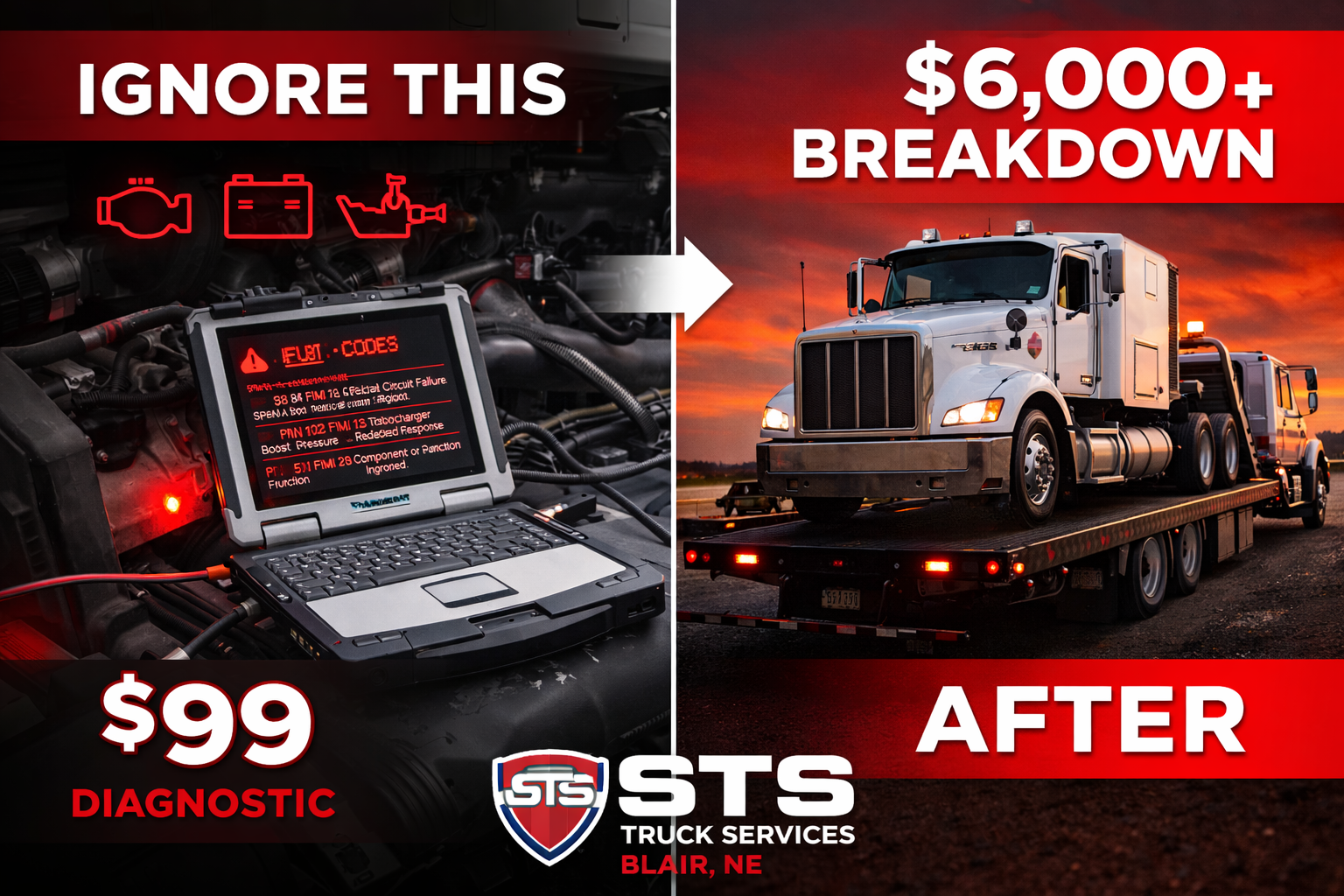
Reading a code is not the same as diagnosing the failure. A fault code points you toward a system. It does not always prove which part failed, why it failed, or whether another issue is causing the symptom.
That difference matters. Guessing wrong can turn one warning light into multiple repairs, repeat downtime, unnecessary parts, and a truck that still has the same problem when it leaves. At STS Truck Services, we focus on finding the real issue so the repair plan is based on evidence, not assumptions.
The Real Cost Is Usually the Wrong Repair, Not the Diagnostic Time
Most customers do not lose money on proper diagnostics. They lose money when parts are replaced without proof, the truck comes back with the same complaint, and downtime keeps stacking up. A strong diagnostic process helps stop that cycle.
Diagnostics and Electrical Issues We Help Solve
Electrical and diagnostic issues can involve multiple systems at once. The right process helps narrow the problem and protect the truck from unnecessary downtime.
Check Engine Lights
A check engine light can point to anything from a smaller sensor issue to a condition that can lead to derate, emissions trouble, or expensive downtime if ignored.
No-Start Conditions
Starting issues can involve batteries, starters, wiring, sensors, fuel delivery, control modules, or multiple systems working together.
Electrical Faults
Wiring problems, loose connections, voltage drops, grounds, charging problems, and harness issues can create intermittent problems that need careful diagnosis.
Sensor and Fault Code Issues
A code may identify a circuit or system, but the right repair depends on confirming whether the sensor, wiring, connector, power supply, or another failure is responsible.
Emissions and Derate Concerns
Emissions-related faults can create warning lights, performance issues, derates, and downtime if the root cause is not traced correctly.
Power Loss and Driveability Problems
Low power, rough running, black smoke, throttle response issues, and performance complaints all need a diagnostic process that connects symptoms to the real failure.
Why “Just Clear the Code” Is Not a Repair Strategy
Clearing a code may turn off a light for a moment, but it does not fix the condition that triggered it. If the cause is still there, the truck can come back worse, more expensive, and under more schedule pressure.
What Proper Diagnosis Protects
Proper diagnostic work protects you from repeat visits, unnecessary parts replacement, longer downtime, and repair decisions built on the first clue instead of the full picture.
Why It Matters Operationally
When a truck is down for an electrical or diagnostic issue, uncertainty is expensive. The faster you get a clear answer, the faster you can make the right repair decision.
Warning Signs You Should Not Ignore
Trucks usually give clues before they fail completely. The sooner those clues are diagnosed correctly, the more control you keep over cost and downtime.
Warning Lights or Active Faults
Check engine lights, emissions lights, ABS lights, and other active warnings should be reviewed before they create a larger service interruption.
Intermittent Electrical Problems
Problems that come and go can be some of the most frustrating. They often require a deeper look at wiring, connectors, grounds, and voltage behavior.
Battery or Charging Concerns
Weak starts, dim lights, charging problems, or repeated battery issues may point to more than a bad battery.
Burning Smells or Damaged Wiring
Heat, melted insulation, burnt smells, corrosion, or damaged harnesses can become serious if the source is not handled quickly.
Power Loss or Poor Response
Low power, poor throttle response, black smoke, rough running, and fuel or air delivery symptoms need a process that proves the actual cause.
No-Start or Hard-Start Issues
A no-start is not always one part. It may involve electrical power, controls, sensors, fuel supply, or communication between systems.
Check Engine Light Diagnostics Are More Than Code Reading
A fault code is a clue, not a final answer. STS uses symptoms, testing, circuit checks, system behavior, and operating conditions to determine whether the problem is a failed part, wiring issue, voltage concern, sensor fault, module issue, or another condition causing the code.
Fault Code Interpretation
We look at what the code means, when it sets, and whether it matches the actual complaint.
Live Data and System Behavior
Sensor readings, temperatures, pressures, voltages, and commanded values can help show what the truck is actually doing.
Confirmed Repair Direction
The goal is to prove the failure before recommending parts whenever possible.
No-Start and Hard-Start Diagnostics
A no-start can feel simple from the driver's seat, but it can involve several systems. Guessing at batteries, starters, sensors, or fuel parts can get expensive quickly if the real cause is not confirmed.
Battery, Cable & Ground Testing
Weak batteries, poor cable condition, bad grounds, corrosion, and voltage drop can all create starting problems.
Starter and Charging Concerns
Starter draw, alternator output, charging performance, and related wiring need to be evaluated together.
Fuel, Sensor & Control Inputs
Fuel delivery, crank/cam sensors, communication faults, modules, and safety interlocks can all contribute to a no-start.
Electrical Faults, Wiring Problems, and Intermittent Issues
Electrical problems are often frustrating because they may come and go. Heat, vibration, moisture, corrosion, poor connections, voltage drops, and damaged harnesses can all create symptoms that disappear by the time the truck reaches the shop.
Voltage Drop and Circuit Testing
Testing power, ground, load, and circuit behavior helps find problems that visual inspection alone can miss.
Harness and Connector Concerns
Rubbed wiring, loose pins, corrosion, damaged insulation, and poor connector fit can create repeat faults.
Intermittent Complaint Strategy
Intermittent faults require a process that considers vibration, heat, moisture, operating conditions, and driver observations.
Diagnostics Supports the Repairs That Keep Trucks Moving
Diagnostic work is often the starting point for the repairs that protect uptime. A clear diagnosis helps guide the next step instead of sending the truck into a chain of disconnected repairs.
How STS Approaches Diagnostic Work
The goal is not to sell a guess. The goal is to understand the complaint, trace the issue, and give you a repair direction that makes sense.
Start With the Complaint
We look at what the truck is actually doing: warning lights, symptoms, driver complaints, performance changes, and when the issue shows up.
Connect Codes to Real Conditions
Codes are useful, but they are not the final answer. They need to be interpreted alongside symptoms, testing, and system behavior.
Test Before Replacing
Whenever possible, we work to confirm the failure before recommending parts so the repair is based on proof.
Look for Root Cause
Replacing the visible failed part may not solve the issue if wiring, voltage, contamination, heat, or another condition caused the failure.
Explain the Next Step
You should know what was found, why it matters, and what repair path makes the most sense for uptime and cost control.
Frequently Asked Questions About Truck Diagnostics and Electrical Repair
Diagnostic questions are common because the symptom you see is not always the same as the failure that caused it.
Is reading a fault code the same as diagnosing the problem?
No. A code points toward a system or circuit, but testing confirms the failure, the cause, and whether wiring, voltage, sensors, modules, or another related issue is responsible.
Why does the same check engine light keep coming back?
A recurring light can mean the root cause was not corrected, a related system is creating the fault, or the previous repair was based on the code instead of confirmed testing.
What can cause a diesel truck no-start condition?
No-start conditions can involve batteries, starters, cables, grounds, wiring, sensors, fuel delivery, communication faults, control modules, or multiple systems working together.
Can a bad sensor cause a derate?
Yes. Sensor faults, wiring problems, communication faults, emissions faults, and inaccurate data can all contribute to derates, warning lights, and performance limits.
Why are intermittent electrical problems hard to diagnose?
They may only appear under certain heat, vibration, load, moisture, or voltage conditions, which means testing must focus on wiring, grounds, connectors, circuits, and operating behavior.
How does proper diagnostics save money?
Proper diagnostics can reduce unnecessary parts replacement, repeat repairs, comeback downtime, and larger failures by confirming the real cause before repair decisions are made.
Warning Light, No-Start, or Electrical Problem?
Do not let guessing turn into wasted parts, repeat downtime, and a bigger repair bill. Get the truck diagnosed before the problem controls the schedule.
Contact STS Truck Services
Reach out for truck diagnostics, electrical faults, check engine lights, no-start conditions, emissions issues, power-loss complaints, and uptime-focused repair support.
Reach the Shop
Phone: 402-533-2056
Email the Shop: stsrepair@sterlingtransportationservices.com
Address: 270 Grant Street, Blair, NE 68008
Service Area
Blair, Nebraska
Omaha, Nebraska
Fremont, Nebraska
Council Bluffs, Iowa
Missouri Valley, Iowa
I-29 and I-80 corridors