Stop Turning $400 Maintenance Into a $6,000 Breakdown
Most expensive truck repairs do not start as emergencies. They start as missed intervals, stretched service, ignored warning signs, and maintenance that gets pushed until the truck makes the decision for you. STS Truck Services helps fleets and owner-operators move from reactive repairs to OEM-based maintenance planning built around uptime.
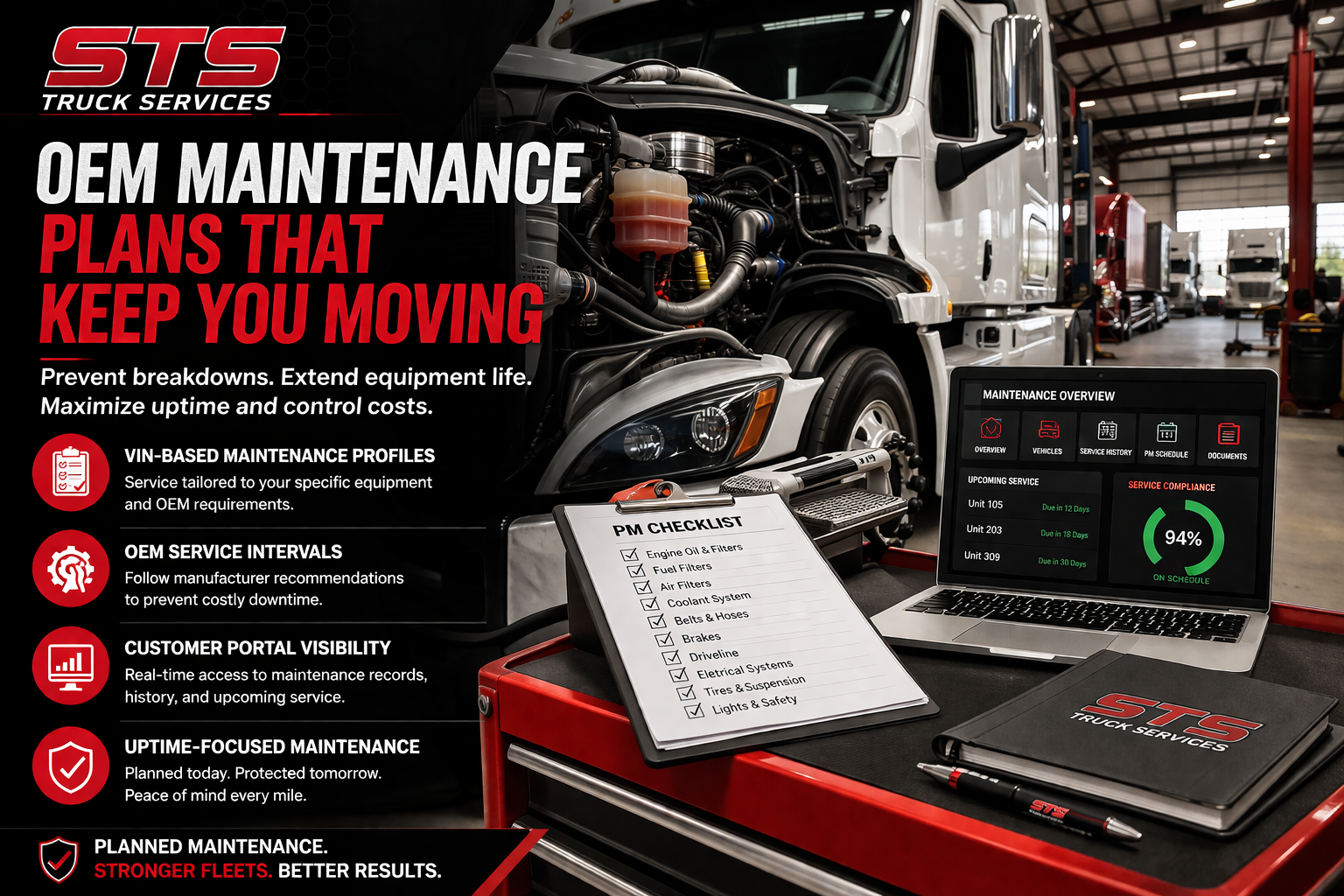
We use the truck, the VIN, the engine, the mileage, the duty cycle, and OEM service intervals to create a clearer maintenance path—so you know what is due, what is coming next, and what can be planned before it becomes downtime.
What You Gain
- Fewer avoidable breakdowns
- Clearer maintenance timing
- Better records and service visibility
- More control over downtime and repair decisions
Most Fleets Do Not Have a Repair Problem. They Have a Missed-Maintenance Problem.
The expensive failure is usually the last step in a chain reaction. A service interval gets stretched, a small issue gets postponed, the truck keeps running, and eventually the repair is no longer optional.
Reactive Maintenance
- Trucks come in after the warning signs have already been ignored.
- Repairs happen when the truck is down, not when the schedule makes sense.
- Downtime gets decided by failure, not by planning.
- Costs climb because small service items are allowed to become big problems.
OEM-Based Maintenance Planning
- Service is planned around manufacturer intervals and real truck usage.
- Each unit has clearer records and maintenance expectations.
- Repair decisions are made earlier, with more control and less pressure.
- Downtime is easier to schedule before the truck forces it on you.
The $400 Service Is Not the Problem. The $6,000 Breakdown Is.
The point of preventive maintenance is not to sell unnecessary work. The point is to protect the truck, the driver, the schedule, and the revenue behind that unit. A planned service is easier to budget than a roadside failure, a tow bill, missed loads, parts delays, and a repair that could have been prevented.
What Makes the STS OEM Maintenance Plan Different
This is not a generic oil-change reminder. It is a structured maintenance process built around the actual truck, the actual engine, and the service intervals it should be following.
VIN-Based Truck Profiles
We build each maintenance plan around the unit itself, including VIN, engine type, mileage, service history, and how the truck is being used.
OEM Service Intervals
Maintenance timing is based on manufacturer guidance instead of guesswork, memory, or a one-size-fits-all schedule.
Customer Portal Access
Your portal helps provide visibility into service history, invoices, maintenance activity, and what has been done to each unit.
Better Repair Prioritization
Not every issue carries the same risk. We help identify what needs attention now and what can be planned more strategically.
Fleet and Owner-Operator Support
Whether you manage multiple trucks or depend on one truck to earn, the goal is the same: fewer surprises and more control.
Uptime-Focused Communication
We explain what matters, why it matters, and how it affects downtime, repair cost, and reliability.
No Membership Fees. No Monthly Charges. No Portal Fees.
The STS OEM Maintenance Program is designed to help customers stay ahead of costly breakdowns—not add another monthly bill. There is no enrollment fee, no monthly maintenance-plan fee, no charge for customer portal access, and no charge for maintenance tracking. You only pay for the maintenance and repair services your truck actually needs.
Customer Portal Visibility Supports the Maintenance Plan
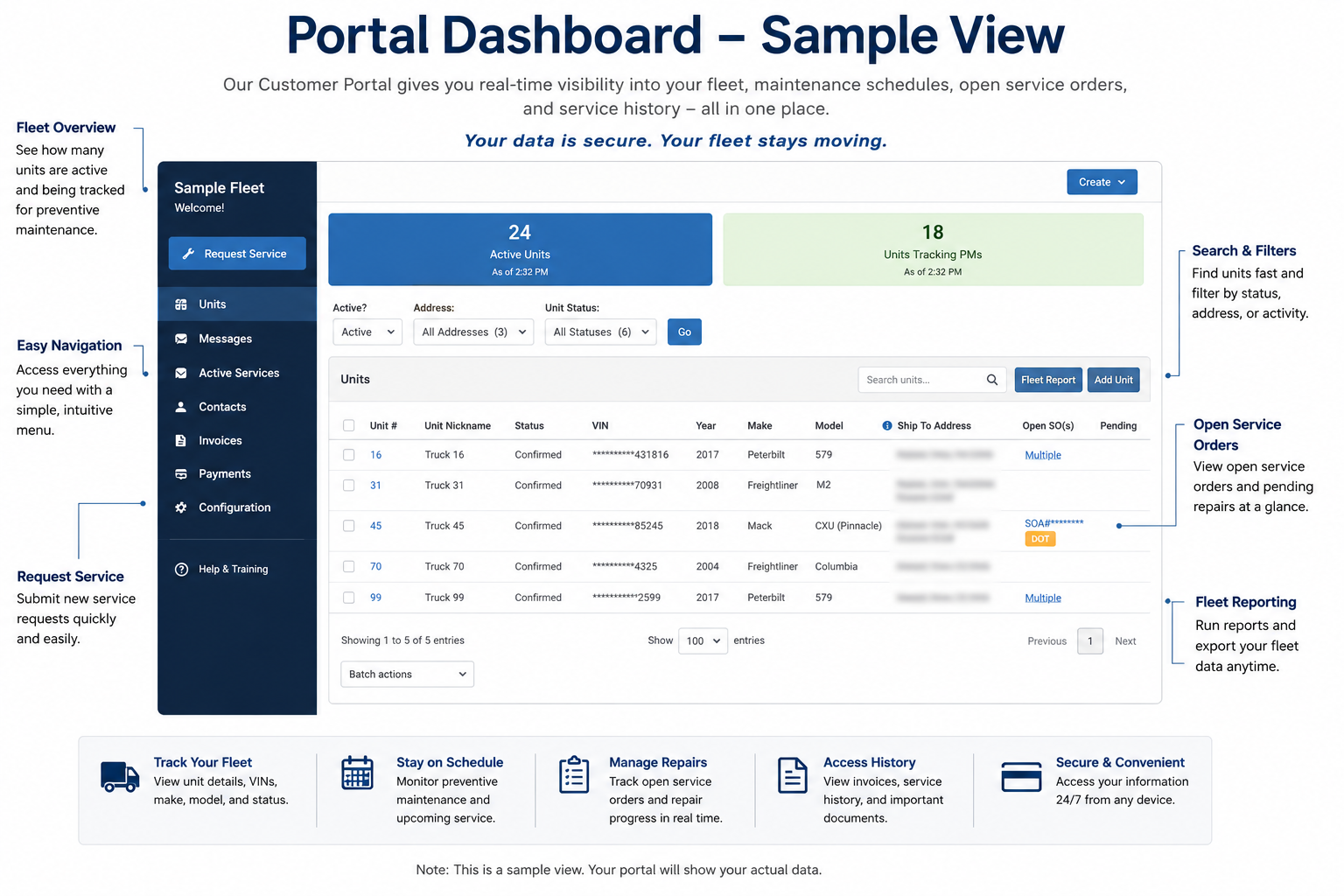
A maintenance plan works best when the customer can see what is happening. The STS customer portal helps organize service requests, unit records, invoices, inspection notes, and maintenance activity so fleets and owner-operators have better visibility into the work being performed.
Know what is due, what was done, and what needs attention next.
OEM-based maintenance planning is not just about remembering an oil change. It is about keeping records, service history, repair communication, and PM tracking organized enough to make better decisions before missed maintenance becomes downtime.
How the Program Works
We keep the process simple: understand the truck, build the profile, track what is done, and help you stay ahead of what is coming next.
From Guesswork to a Real Maintenance Plan
A strong PM program gives you more than a list of services. It gives you a repeatable way to protect the unit before the unit becomes a problem.
Maintenance is easier to schedule than failure.
A routine PM can often catch the kind of wear, leaks, loose components, fluid concerns, and service needs that later become major downtime. The earlier you find it, the more control you keep.
That is why the real value is not a monthly program fee—it is avoiding the larger repair event that comes from waiting too long. You only pay when maintenance or repairs are performed.
Built for Fleets, Owner-Operators, and Busy Trucks That Cannot Afford Surprise Downtime
If your truck is working, it needs a maintenance plan that fits real operating conditions—not perfect-world assumptions.
For Fleets
Multiple units create multiple maintenance timelines. A structured plan helps bring consistency, visibility, and control to what each truck needs and when it needs it.
For Owner-Operators
When one truck is your income, downtime hits fast. OEM-based planning helps you stay ahead of service needs instead of losing control when the truck goes down.
Better Records
Cleaner maintenance history helps with planning, compliance conversations, resale value, and faster decision-making.
Better Scheduling
Planned maintenance can be worked into your schedule. Emergency downtime usually cannot.
Better Cost Control
Preventive service is more predictable than roadside failures, urgent repairs, and downtime that disrupts work.
Common Maintenance Areas We Help Track
Every unit is different, but a strong maintenance plan helps keep the major risk areas visible before they create larger problems.
Why Fleets Across Eastern Nebraska and Western Iowa Choose STS
Fleets need more than repairs. They need visibility, communication, maintenance consistency, and a shop that understands how downtime affects schedules, drivers, customers, and revenue.
Inspection Photos & Documentation
Technician findings, inspection notes, and supporting photos help provide clearer visibility into what was found and why recommendations matter.
Customer Portal Visibility
Fleet managers and owners can review service history, invoices, maintenance activity, and inspection findings through the customer portal.
Downtime-Focused Planning
OEM-based maintenance planning helps reduce preventable failures that interrupt schedules, deliveries, drivers, and customer commitments.
Commercial Truck Specialization
STS focuses on heavy-duty diesel trucks, trailers, fleets, and commercial vehicles operating throughout Blair, Omaha, Fremont, Council Bluffs, Missouri Valley, I-29, and I-80, the I-29 corridor, and the I-80 corridor.
Fleet PM Cost & Downtime Calculator
Reactive repairs are usually the most expensive repairs. Use this calculator to estimate how much unplanned downtime and emergency repairs may really be costing your operation every year.
Estimate Your Preventable Downtime Exposure
This estimator demonstrates how delayed maintenance can quickly become major downtime and repair expense. STS Truck Services builds OEM-based maintenance plans around uptime and preventing avoidable breakdowns.
OEM Maintenance Plan FAQs
Common questions from fleets, owner-operators, and commercial truck customers about preventative maintenance planning and uptime-focused service.
What does OEM-based maintenance mean?
OEM-based maintenance follows manufacturer-recommended service intervals and maintenance guidelines based on the truck, engine, mileage, and operating conditions.
Can STS track maintenance by VIN?
Yes. Maintenance planning can be built around VIN-specific truck profiles, service history, and fleet maintenance records.
Do you provide inspection photos?
Yes. STS provides technician notes and inspection photos through the customer portal to help improve visibility and communication.
Is there a cost to be enrolled in the OEM Maintenance Program?
No. STS does not charge an enrollment fee, monthly subscription fee, portal access fee, or maintenance tracking fee. Customers only pay for the maintenance and repair services performed on their equipment.
Can owner-operators use the PM program?
Absolutely. Preventative maintenance planning helps owner-operators reduce surprise downtime and better control repair scheduling.
Want to Know What Your Truck Should Be Getting Before It Breaks?
Request a PM review and let STS Truck Services help build an OEM-based maintenance path around your unit or fleet before missed maintenance turns into expensive downtime. There is no enrollment fee, monthly plan fee, or portal access fee—you only pay for the actual services performed.
Customer Portal and PM Planning
How does the customer portal support OEM maintenance planning?
The customer portal helps keep service requests, unit history, PM activity, open service orders, invoices, inspection notes, and maintenance communication organized in one place.
Contact STS Truck Services About OEM Maintenance Plans
Reach out for VIN-based maintenance profiles, OEM service interval planning, PM reviews, customer portal visibility, inspection follow-up, and uptime-focused fleet support with no enrollment fee, monthly plan fee, or portal access fee.
Reach the Shop
Phone: 402-533-2056
Email the Shop: stsrepair@sterlingtransportationservices.com
Address: 270 Grant Street, Blair, NE 68008
Service Area
Blair, Nebraska
Omaha, Nebraska
Fremont, Nebraska
Council Bluffs, Iowa
Missouri Valley, Iowa
I-29 and I-80 corridors
Quick PM Review Request
Not ready to use the repair portal yet? Send a quick maintenance-plan note to the shop. There is no enrollment fee, monthly plan fee, portal access fee, or maintenance tracking fee.
This opens your email app so you can review the message before sending.