Farmers, grain haulers, and agricultural operations already have enough pressure during harvest. The last thing they need is a truck sitting on the side of the road, a trailer with brake problems, a dead battery, a coolant leak, a check engine light, or a tire failure when loads need to move.
At STS Truck Services in Blair, Nebraska, we believe the farmer is the hero of the story. You grow the crop, manage the timing, carry the risk, and keep the operation moving. Our job is to help you find problems early, understand what matters, and reduce the risk of preventable downtime.
The Real Problem Is Not the Repair. It Is When the Repair Happens.
Every truck and trailer eventually needs service. Before harvest, a repair can often be planned, scheduled, prioritized, and budgeted. During harvest, that same repair can become a crisis.
A small coolant leak can become an overheated truck. A weak battery can become a no-start. A worn brake component can become a safety or DOT concern. Uneven tire wear can become a roadside failure. A trailer ABS problem can become a compliance headache, and a check engine light can become a derate or forced shutdown.
The problem is not always the repair itself. The problem is losing control of the timing. A pre-harvest inspection gives you information before the season gets busy so you can decide what needs attention now, what can be planned, and what can be monitored.
Farmers Need a Plan Before the Pressure Hits
You would not wait until harvest starts to wonder if the combine is ready. Trucks and trailers are part of the same harvest system. If they fail, the operation slows down.
- Schedule the inspection. Bring the truck or trailer in before harvest begins.
- Inspect the equipment. We look at systems that can create downtime, safety problems, DOT concerns, or repair surprises.
- Review the written report. You receive clear findings and recommended repairs.
- Prioritize the work. Decide what should be repaired before harvest, what can be monitored, and what can be planned.
- Go into harvest prepared. No inspection can guarantee nothing will fail, but it can help reduce preventable surprises.
What We Check on a Pre-Harvest Truck Inspection
A pre-harvest truck inspection is designed to identify issues that can affect uptime, performance, safety, and DOT readiness during one of the busiest times of the year.
Engine & Diagnostics
- Check engine and warning lights
- Active and inactive fault codes
- DEF and regeneration concerns
- Engine performance complaints
Cooling System
- Coolant level and condition
- Radiator and charge-air cooler
- Hoses, clamps, water pump and leaks
- Fan clutch and fan blades
Batteries, Belts & Fluids
- Battery condition and charging voltage
- Starter operation
- Belts, hoses and clamps
- Fluid levels and visible leaks
Brakes & Air System
- Brake linings, drums and chambers
- Slack adjusters
- Air tanks, dryer and leaks
- Brake hoses and governor operation
Steering, Suspension & Tires
- Steering linkage and components
- Springs, air bags, bushings and shocks
- Tread depth, pressure and wear patterns
- Wheels and visible wheel-end concerns
Lights & DOT Safety Items
- Headlights, marker and brake lights
- Turn signals and reflectors
- Mirrors, windshield and wipers
- Required safety equipment, when applicable
What We Check on a Pre-Harvest Trailer Inspection
A truck may be ready, but if the trailer fails, the load still does not move. Trailer inspections focus on the components most likely to affect safe, reliable harvest hauling.
Brakes, Air & ABS
- Brake linings, drums or rotors
- Chambers, slack adjusters and air lines
- Glad hands, tanks and leaks
- ABS light, wiring and diagnostic faults
Tires, Wheels & Wheel Ends
- Tread depth and tire pressure
- Uneven wear and sidewall damage
- Hub oil and wheel seals
- Lug nuts and visible bearing concerns
Suspension & Structure
- Springs, air bags and bushings
- Torque arms, shocks and U-bolts
- Frame rails and crossmembers
- Doors, hinges, latches and seals
Coupling & Cargo Equipment
- Kingpin and upper coupler area
- Landing gear and mounting
- Tarp systems, where applicable
- Grain gates, hopper doors and other cargo equipment
For the full inspection breakdown, see our Pre-Harvest Truck & Trailer Inspection Guide.
The Enemy: Unplanned Downtime
Unplanned downtime steals control. It tends to happen when the truck is loaded, the elevator line is long, the weather is changing, drivers are already working long hours, parts are harder to get, and you have the least time to deal with it.
The real value of a pre-harvest inspection is not just finding problems. It is helping you avoid the chaos of finding those problems too late.
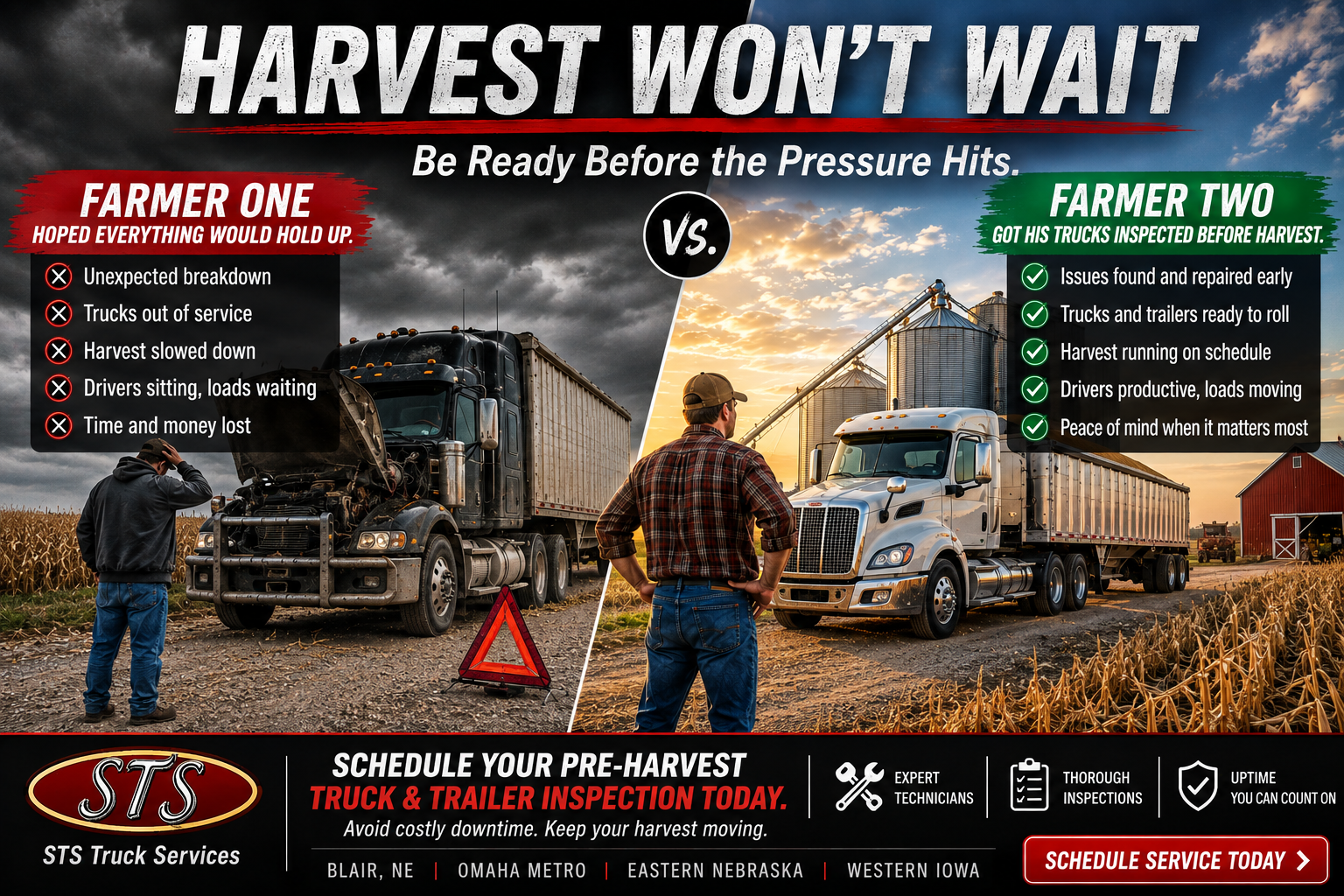
Two Farmers, Two Different Outcomes
Farmer One Waits
A truck has been sitting most of the summer. It started last week, so it seems ready. A few days into harvest, a slowly developing coolant leak becomes serious and the truck overheats while loaded. Now the truck is down, the load is delayed, and the repair has to be handled in a rush.
The repair may have been manageable before harvest. During harvest, it becomes stress, downtime, and lost productivity.
Farmer Two Calls STS
The second farmer schedules an inspection before the season. A small coolant leak, weak battery, and trailer light issue are found before any of them cause a breakdown. The findings are reviewed, the important repairs are handled, and the equipment goes into harvest prepared.
There is still plenty to manage during harvest, but preventable truck downtime is less likely to be one of the problems.
Who Should Schedule a Pre-Harvest Inspection?
Pre-harvest inspections are a good fit for farmers, grain haulers, agricultural fleets, owner-operators, co-ops, agribusinesses, commercial truck owners, trailer owners, and other businesses that depend on trucks during harvest.
STS Truck Services provides heavy-duty truck and trailer repair from our shop in Blair, Nebraska, serving customers throughout Blair, Omaha, Fremont, Council Bluffs, Missouri Valley, Washington County, eastern Nebraska, western Iowa, and surrounding agricultural communities.