CumminsSPN 4374FMI 31DEF Pump / Motor Speed
SPN 4374 FMI 31 — Aftertreatment DEF Pump Motor Speed Condition Exists
What it generally indicates: On Cummins-oriented SPN/FMI references, SPN 4374 identifies aftertreatment DEF pump motor speed; FMI 31 indicates that a monitored condition exists rather than identifying one failed part by itself.
What STS would consider next: Confirm the engine and aftertreatment application, review related DEF faults, and test DEF supply, pressure response, pump operation, wiring/connectors, restrictions, air entry, and crystallization before condemning the pump.
Source used for this explanation: SPN 4374 DEF Pump Motor Speed / Pressure reference.
CumminsSPN 4374FMI 2DEF Pump / Motor Speed
SPN 4374 FMI 2 — DEF Pump Motor Speed Data Erratic or Incorrect
What it generally indicates: This combination points toward an erratic, intermittent, or incorrect DEF-pump motor-speed signal or operating condition.
What STS would consider next: Verify the exact Cummins application and related faults, then inspect DEF supply and filter condition, aeration, connectors and wiring, commanded-versus-actual pump behavior, and pump performance before replacing components.
Source used for this explanation: SPN 4374 DEF Pump Motor Speed / Pressure reference.
CumminsSPN 3246FMI 2DPF Outlet Temperature
SPN 3246 FMI 2 — DPF Outlet Temperature Signal Erratic or Incorrect
What it generally indicates: Cummins fault-code references identify this combination with the aftertreatment DPF outlet-temperature sensor signal being erratic, intermittent, incorrect, or not rational for operating conditions.
What STS would consider next: Confirm the engine calibration and related faults, compare temperature readings, and inspect the outlet-temperature sensor, connector, harness, and associated temperature-sensing circuitry before replacing parts.
Source used for this explanation: Cummins fault-code reference.
CumminsSPN 3521FMI 18DEF Quality / Property
SPN 3521 FMI 18 — DEF Property Below Normal Operating Range
What it generally indicates: Cummins lists this as an aftertreatment DEF-property fault in which the reported value is below the normal operating range at a moderately severe level.
What STS would consider next: Confirm DEF concentration and condition, check for contamination or dilution, review related DEF-quality faults, and verify the DEF quality/level/temperature sensor assembly and its electrical/data-link operation before determining the repair.
Source used for this explanation: Cummins L9 fault-code reference.
CumminsSPN 4360FMI 2SCR Intake Temperature
SPN 4360 FMI 2 — SCR Intake Temperature Signal Erratic or Incorrect
What it generally indicates: Cummins fault-code material identifies this as an aftertreatment SCR intake-temperature sensor signal that is erratic, intermittent, or incorrect.
What STS would consider next: Compare actual aftertreatment temperature readings, inspect the SCR intake-temperature sensor and connector, check harness integrity and related temperature faults, and confirm the application before replacing the sensor.
Source used for this explanation: Cummins ISX12 / ISX11.9 fault-code reference.
CumminsSPN 3361FMI 4DEF Dosing Unit
SPN 3361 FMI 4 — DEF Dosing Unit Voltage Below Normal
What it generally indicates: Cummins identifies this combination as aftertreatment DEF dosing-unit voltage below normal or shorted to a low source.
What STS would consider next: Verify the exact engine/application, inspect dosing-unit power, ground, connectors and harness for shorts or high resistance, review related DEF faults, and electrically test the dosing unit before replacement.
Source used for this explanation: Cummins J1939 diagnostic-code table.
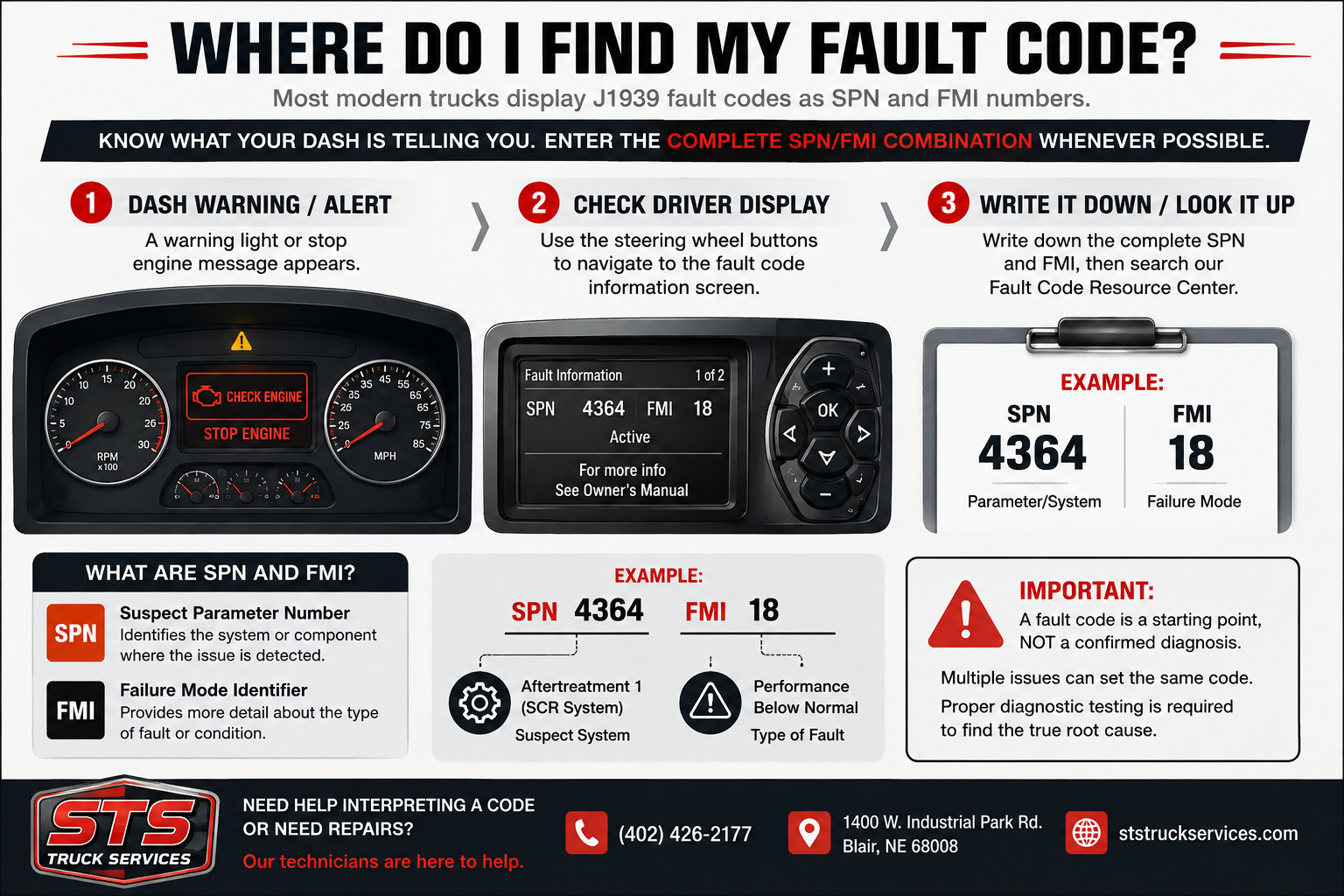
Detroit / FreightlinerSPN 4364FMI 18Aftertreatment / SCR
SPN 4364 FMI 18 — SCR NOx Conversion Efficiency Low
What it generally indicates: The aftertreatment control module detects that SCR NOx conversion efficiency is low.
What STS would consider next: Possible areas include DEF quality/concentration, NOx sensor bias, DEF buildup, aftertreatment temperature, DPF maintenance, or internal aftertreatment damage. Related air-management, EGR, fuel, and NOx-sensor faults should be considered before condemning parts.
Source used for this explanation: Detroit Diesel / DTNA.
Detroit / FreightlinerSPN 4374FMI 0DEF Pressure / Pump
SPN 4374 FMI 0 — DEF Pump Speed High / Under-Pressurized DEF System
What it generally indicates: Detroit identifies this as an under-pressurized DEF-system diagnostic in which pump operation is abnormal for the pressure being produced.
What STS would consider next: The DEF supply, pressure behavior, restrictions, leaks/air entry, dosing system, connections, and pump operation may need testing before a component is replaced.
Source used for this explanation: Detroit Diesel / DTNA.
Detroit / FreightlinerSPN 3216FMI 16Inlet NOx Sensor
SPN 3216 FMI 16 — Inlet NOx Sensor Plausibility
What it generally indicates: The aftertreatment inlet NOx sensor signal fails an OEM plausibility check.
What STS would consider next: A plausibility fault does not automatically prove the sensor has failed. Related faults, wiring/connectors, power and ground, exhaust conditions, and sensor operation may need evaluation.
Source used for this explanation: Detroit Diesel / DTNA.
Detroit / FreightlinerSPN 520328FMI 7DEF Pressure
SPN 520328 FMI 7 — DEF Pressure Too High
What it generally indicates: This diagnostic detects a DEF-system over-pressure condition.
What STS would consider next: Actual pressure behavior, related faults, plumbing, dosing-system operation, wiring, and pressure-control components should be checked before parts are condemned.
Source used for this explanation: Detroit Diesel / NHTSA.
Detroit / FreightlinerSPN 521049FMI 31DEF / Aftertreatment
SPN 521049 FMI 31 — Related DEF System Fault Present
What it generally indicates: Detroit documentation describes this code as setting when qualifying DEF level, dosing, pump, NOx, or related aftertreatment faults are present.
What STS would consider next: The underlying active DEF/aftertreatment faults should be identified and diagnosed first rather than treating this as a stand-alone failed component.
Source used for this explanation: Detroit Diesel / DTNA.
Detroit / FreightlinerSPN 3216FMI 14Inlet NOx Sensor
SPN 3216 FMI 14 — Inlet NOx Sensor Self-Diagnosis Not Supported
What it generally indicates: The inlet NOx sensor control unit reports that self-diagnosis is not supported.
What STS would consider next: Detroit's published procedure notes this can indicate an incorrect inlet NOx sensor has been installed. Correct application/part identification should be verified.
Source used for this explanation: Detroit Diesel / DTNA.
Detroit / FreightlinerSPN 3226FMI 20Outlet NOx Sensor
SPN 3226 FMI 20 — SCR Outlet NOx Sensor Drift Low
What it generally indicates: The SCR outlet NOx sensor fails an OEM drift/plausibility check.
What STS would consider next: Other outlet-NOx faults should be considered first. Exhaust leaks or aftertreatment damage can affect the diagnostic, so the system should be inspected before a sensor is condemned.
Source used for this explanation: Detroit Diesel / NHTSA.
Detroit / FreightlinerSPN 3246FMI 0DPF Temperature
SPN 3246 FMI 0 — DPF Outlet Temperature Very High
What it generally indicates: The DPF outlet temperature exceeds the OEM high-temperature threshold.
What STS would consider next: Fuel-system faults and other DPF outlet-temperature sensor faults may need to be diagnosed first. Sensor behavior, wiring, exhaust conditions, and regeneration performance should be checked.
Source used for this explanation: Detroit Diesel / NHTSA.
Detroit / FreightlinerSPN 3251FMI 0DPF Pressure
SPN 3251 FMI 0 — DPF Pressure Out of Range Very High
What it generally indicates: Detroit describes this as DPF pressure being above the very-high threshold.
What STS would consider next: A restriction in the exhaust/aftertreatment system or a pressure-sensing problem may be involved. Pressure sensors, tubes/ports, DOC/DPF restriction, and related conditions require testing.
Source used for this explanation: Detroit Diesel / NHTSA.
Detroit / FreightlinerSPN 3251FMI 1DPF Pressure
SPN 3251 FMI 1 — DPF Pressure Out of Range Low
What it generally indicates: Pressure across the DPF is below the expected range.
What STS would consider next: Pressure sensors, sensor tubes/ports, restrictions, exhaust hardware, and DPF condition can all affect the reading. The low-pressure code should be diagnosed rather than assumed to be a bad sensor.
Source used for this explanation: Detroit Diesel / NHTSA.
Detroit / FreightlinerSPN 3251FMI 16DPF Pressure
SPN 3251 FMI 16 — DPF Pressure Out of Range High
What it generally indicates: DPF outlet/differential pressure is above the OEM high threshold.
What STS would consider next: A restriction or pressure-sensing issue may be present. Detroit procedures check sensor voltage and aftertreatment restriction before determining the repair.
Source used for this explanation: Detroit Diesel / NHTSA.
Detroit / FreightlinerSPN 3251FMI 20DOC / DPF Pressure
SPN 3251 FMI 20 — DOC Inlet Pressure Not Plausible
What it generally indicates: The DOC inlet pressure signal is not plausible compared with expected aftertreatment pressure behavior.
What STS would consider next: Exhaust leaks/damage, pressure-sensor readings, connectors, wiring, tubes, elbows, kinks, leaks, or restrictions can be involved.
Source used for this explanation: Detroit Diesel / NHTSA.
Detroit / FreightlinerSPN 3719FMI 0DPF Soot Load
SPN 3719 FMI 0 — Soot Level Very High
What it generally indicates: Detroit identifies this as a very-high DPF soot-load condition.
What STS would consider next: This is a regeneration/soot-load warning that needs prompt attention. The cause of excessive soot loading or unsuccessful regeneration should still be evaluated if the condition returns.
Source used for this explanation: Detroit Diesel / NHTSA.
Detroit / FreightlinerSPN 3719FMI 16DPF Soot Load
SPN 3719 FMI 16 — Soot Level High
What it generally indicates: Detroit identifies this as a high DPF soot-load condition.
What STS would consider next: The published procedure calls for regeneration when appropriate, but recurring soot loading can point to an underlying engine or aftertreatment problem that should be diagnosed.
Source used for this explanation: Detroit Diesel / NHTSA.
Detroit / FreightlinerSPN 3719FMI 31DPF Regeneration
SPN 3719 FMI 31 — DPF Regeneration Lamp / Regen Zone 2
What it generally indicates: Detroit describes this as an informational code logged when the DPF regeneration lamp is flashing in Regen Zone 2.
What STS would consider next: If active, Detroit states that a stationary regeneration is required; if inactive, the code is informational. Repeated regeneration demand can still justify checking the underlying soot-loading cause.
Source used for this explanation: Detroit Diesel / NHTSA.
Detroit / Freightliner
SPN 2631
FMI 1
Air Management / Intake Airflow
SPN 2631 FMI 1 — Low Air Flow
What it generally indicates: Detroit sets this code when the engine remains in smoke-mode control too long because clean airflow into the engine is inadequate.
What STS would consider next: Air-management diagnosis can include barometric and intake-manifold pressure readings, EGR delta-pressure operation, intake restrictions/leaks, charge-air system condition, and related faults. Detroit notes a 25% derate for this diagnostic.
Source used for this explanation: Detroit Diesel / DTNA.
Detroit / Freightliner
SPN 2659
FMI 0
EGR Flow
SPN 2659 FMI 0 — EGR Flow Target Error, High Flow
What it generally indicates: The actual EGR flow is higher than commanded by more than the calibrated threshold.
What STS would consider next: Related EGR valve, EGR delta-pressure, intake-manifold pressure and charge-air conditions may need to be checked first. Detroit's procedure also calls for addressing certain related EGR and sensor codes before continuing.
Source used for this explanation: Detroit Diesel / DTNA.
Detroit / Freightliner
SPN 411
FMI 2
EGR Delta Pressure
SPN 411 FMI 2 — EGR Delta Pressure Sensor Out of Calibration
What it generally indicates: The EGR delta-pressure sensor fails its calibration check.
What STS would consider next: The sensor voltage, venturi/sensor ports, contamination, connector condition and wiring are among the areas Detroit checks before replacement. A restricted or contaminated port can mimic a sensor problem.
Source used for this explanation: Detroit Diesel / DTNA.
Detroit / Freightliner
SPN 3471
FMI 3
Hydrocarbon Doser
SPN 3471 FMI 3 — HC Electronic Dosing Valve Circuit Failed High
What it generally indicates: Detroit identifies this as an electronic dosing valve circuit-high fault in the hydrocarbon dosing system.
What STS would consider next: The OEM procedure checks EDV circuit voltage and wiring before determining whether the metering unit is at fault. This is an electrical diagnostic, not proof by itself that the doser needs replacement.
Source used for this explanation: Detroit Diesel / NHTSA.
Detroit / Freightliner
SPN 3471
FMI 5
Hydrocarbon Doser
SPN 3471 FMI 5 — HC Doser Circuit Failed Open
What it generally indicates: Detroit identifies this as an open-circuit fault in the hydrocarbon doser circuit.
What STS would consider next: The OEM procedure checks for related dosing-valve faults, EDV resistance, supply voltage and harness continuity before identifying the failed component.
Source used for this explanation: Detroit Diesel / NHTSA.
International / MaxxForce
SPN 3471
FMI 1
Aftertreatment Fuel Pressure
SPN 3471 FMI 1 — Aftertreatment Fuel Pressure Below Desired
What it generally indicates: On 2010-era MaxxForce DT, 9 and 10 applications, Navistar identifies this as aftertreatment fuel pressure below the desired level, or low system pressure.
What STS would consider next: The published diagnostic information points to fuel-delivery pressure, a restricted fuel filter, the aftertreatment fuel shutoff valve, or a biased aftertreatment fuel-pressure sensor/circuit as possible areas to test. The engine/application should be confirmed before using this definition.
Source used for this explanation: Navistar MaxxForce DT/9/10 Diagnostic Manual (EGES-455 mirror).
International / MaxxForce
SPN 3471
FMI 10
Aftertreatment Fuel Doser
SPN 3471 FMI 10 — Aftertreatment Fuel Doser Abnormal Rate of Change
What it generally indicates: On 2010-era MaxxForce DT, 9 and 10 applications, this code is associated with abnormal rate-of-change behavior in the aftertreatment fuel doser.
What STS would consider next: Navistar diagnostic material identifies the aftertreatment fuel doser as a primary area to evaluate. STS would still confirm the engine/application and test the circuit and doser operation before replacing a component.
Source used for this explanation: Navistar MaxxForce DT/9/10 Diagnostic Manual (EGES-455 mirror).
Mack / Volvo
SPN 3471
FMI 14
Aftertreatment Fuel Pressure
SPN 3471 FMI 14 — Aftertreatment Hydrocarbon Doser Fuel Pressure Too High
What it generally indicates: Mack documentation identifies SPN 3471 as the aftertreatment fuel-pressure control actuator. FMI 14 is listed with aftertreatment hydrocarbon-doser fuel pressure too high.
What STS would consider next: The Mack diagnostic table lists fuel shutoff-valve leakage as a possible cause and notes that regeneration may not be possible. Because SPN definitions can vary by manufacturer, the engine and vehicle application should be confirmed before diagnosis.
Source used for this explanation: Mack Engine Control Module DTC Manual.
Detroit / Freightliner
SPN 521049
FMI 7
DT12 Transmission / TCM
SPN 521049 FMI 7 — DT12 Split Pin Sticking in the Retracted Position
What it generally indicates: Detroit DT12 documentation states that the transmission control module detected a stuck or binding split pin during a shift request.
What STS would consider next: This is a DT12 transmission-specific fault rather than a DEF-system fault. The OEM procedure directs diagnosis toward the split-pin/bushing condition, so transmission application and related faults should be confirmed before repair.
Source used for this explanation: Detroit Diesel / NHTSA — DT12.
Detroit / Freightliner
SPN 2791
FMI 7
EGR Valve Actuator
SPN 2791 FMI 7 — EGR Actuator Failsafe Mode, Motor On
What it generally indicates: Detroit describes this diagnostic as the EGR actuator entering failsafe mode with the motor on.
What STS would consider next: Voltage faults are checked first. Detroit then evaluates the actuator linkage, actuator travel, EGR valve movement, wiring and actuator status before determining the repair.
Source used for this explanation: Detroit Diesel / NHTSA.
Detroit / Freightliner
SPN 3563
FMI 10
Intake / Barometric Pressure
SPN 3563 FMI 10 — Barometric and Intake Manifold Pressure Rationality Error
What it generally indicates: The difference between barometric pressure and intake-manifold pressure is larger than the calibrated threshold under the diagnostic conditions.
What STS would consider next: Detroit compares actual barometric and intake-manifold pressure values and checks the intake pressure sensor connector and sensor. The published GHG17 diagnostic lists a 25% derate.
Source used for this explanation: Detroit Diesel / NHTSA.
Detroit / Freightliner
SPN 1231
FMI 9
CAN Communication / ACM
SPN 1231 FMI 9 — ACM Communication Fault
What it generally indicates: This Detroit diagnostic involves loss or abnormality of communication with the Aftertreatment Control Module over the vehicle network.
What STS would consider next: Battery-voltage faults and other communication faults should be addressed first. Power, grounds, connectors, wiring and CAN-network integrity may all be involved.
Source used for this explanation: Detroit Diesel / DTNA.
Detroit / Freightliner
SPN 625
FMI 13
CAN Communication / TCM
SPN 625 FMI 13 — TCM System IDs Not Received
What it generally indicates: Detroit describes this as a CAN communication fault in which the expected TCM system-ID message is not received or stops arriving.
What STS would consider next: Battery-voltage and other CAN faults are checked first, followed by CPC connectors, terminating resistance, wiring and network integrity.
Source used for this explanation: Detroit Diesel / DTNA.
Detroit / Freightliner
SPN 1483
FMI 12
Powertrain CAN Communication
SPN 1483 FMI 12 — MCM Information Not Broadcasting on PTCAN
What it generally indicates: The CPC detects that the Motor Control Module is not broadcasting expected information on the powertrain CAN network.
What STS would consider next: Detroit checks battery-voltage faults, whether the MCM is online, MCM power and grounds, connector condition and the PTCAN harness before determining the repair.
Source used for this explanation: Detroit Diesel / DTNA.
Detroit / Freightliner
SPN 108
FMI 2
Ambient Pressure
SPN 108 FMI 2 — Ambient Pressure Plausibility Fault
What it generally indicates: Detroit documentation for the EPA07 MBE 900 identifies this as an ambient-pressure plausibility fault.
What STS would consider next: This entry is application-specific. The exact diagnostic path depends on the engine/platform, which is why STS should verify engine identification and current OEM information before applying a repair decision.
Source used for this explanation: Detroit Diesel / NHTSA.