A check engine light on a heavy-duty truck is easy to ignore when the truck still seems to be running fine. The driver may think, “It’s probably nothing,” “The truck still pulls good,” or “I’ll deal with it later.” Sometimes the issue may be minor. Sometimes the code may be inactive. But sometimes the warning light is the first sign of a problem that can lead to downtime, derate, forced shutdown, or a much larger repair.
At STS Truck Services in Blair, Nebraska, we help fleets, owner-operators, and commercial vehicle owners identify warning light concerns with professional technicians and high-level diagnostic tools. Our goal is simple: help customers understand what the truck is trying to say before a warning becomes expensive downtime.
Manufacturers spend millions of dollars engineering today’s trucks to monitor critical systems. When the check engine light comes on, the truck is telling you that something has fallen outside normal operating conditions. The sooner you understand why, the more options you usually have.
A Check Engine Light Is a Warning — Not a Suggestion
Modern trucks are full of electronic systems, sensors, emissions controls, engine protection features, and communication modules. When something falls outside normal operating range, the truck may trigger a warning light or fault code. That warning is not random. It is part of the truck’s design to alert the operator that a condition needs to be checked.
What a Truck Check Engine Light Can Mean
The problem may be serious.
The truck may be warning of a condition that could lead to derate, shutdown, poor performance, overheating, aftertreatment damage, or another expensive failure.
The problem may be minor.
Sometimes the concern is smaller, such as a sensor fault, temporary condition, or repair item that can be handled before it grows into a larger problem.
The code may be inactive.
An inactive code may not currently be causing a warning condition, but it can still tell an important story about what the truck experienced. It may need to be reviewed, documented, cleared, or monitored.
Good Operators Get Warning Lights Checked Early
A warning light is always easier to deal with when the truck is still in your control. When the light first comes on, you may still have time to schedule a diagnostic appointment, review the code, determine urgency, plan a repair, or monitor the condition if appropriate.
If you wait too long, the truck may make the decision for you. That can mean a derate while loaded, a forced shutdown at the wrong time, a roadside breakdown, lost time, missed deliveries, driver frustration, and a repair that becomes more expensive because it was delayed.
Do Not Wait for Forced Shutdown or Derate
Some warning light issues do not stay small for long. A truck may still run fine today, but depending on the nature of the fault, that same issue can become more serious tomorrow. This is especially true with aftertreatment, DEF, cooling protection, engine sensors, turbocharger faults, electrical communication issues, and engine protection systems.
Many trucks are designed to protect themselves. If a serious condition continues, the truck may reduce power, enter derate, or shut down entirely. It almost never happens at a convenient time. It happens when the truck is loaded, on a schedule, far from the shop, or needed for an important job.
A Quick Code Read Can Save Time and Money
Here is a simple example. A driver notices a check engine light on Monday morning. The truck still runs fine, so the light is ignored. By Wednesday, the condition gets worse and the truck goes into derate on the road while loaded. Now the customer is dealing with delayed delivery, driver downtime, emergency scheduling, possible roadside service, possible towing, and more pressure with fewer options.
Now compare that to bringing the same truck in Monday or Tuesday for a code read. If the issue is minor, the customer gets peace of mind. If the issue is inactive, the code can be reviewed and cleared when appropriate. If the problem is developing into something serious, the customer has a chance to plan the repair before the truck forces the issue.
Waiting Can Cost More Than the Repair
Customers usually do not lose the most money because a code exists. They lose money because the code is ignored until the truck is no longer in their control. A warning light that could have been scheduled during shop hours can turn into a roadside event, missed load, tow bill, rental need, or emergency repair decision.
Emergency vs. Schedule It: How to Think About Warning Lights
Every warning light deserves attention, but not every situation carries the same urgency. The safest decision depends on the warning, how the truck is behaving, and what the diagnostic data shows.
| Situation | Recommended Action | Why It Matters |
|---|---|---|
| Check engine light is on, but the truck runs normally | Schedule diagnostics soon | The fault may still point to an early issue, inactive history, or developing condition. |
| Warning light is flashing or paired with poor performance | Stop and get guidance immediately | Flashing warnings and performance changes can indicate a more serious condition. |
| Derate warning or countdown appears | Schedule service promptly | The truck may reduce power or force a shutdown if the issue is not addressed. |
| High coolant temperature warning | Stop if overheating and do not keep pushing it | Heat can quickly damage expensive engine components. |
| Low oil pressure warning | Stop immediately | Oil pressure problems can cause severe engine damage fast. |
| DEF or aftertreatment warning | Do not delay diagnosis | DEF, SCR, DPF, and emissions faults can lead to derate and downtime. |
Why Clearing the Light Is Not the Same as Fixing the Problem
One of the biggest misconceptions we see is that clearing a check engine light fixes the truck. Clearing a code only removes the warning from the dashboard. If the underlying problem still exists, the light will usually return — and sometimes it comes back with more severe symptoms.
That is why our technicians do not simply erase codes and guess. We determine why the code was set, whether it is active or inactive, what system is affected, and what should happen next.
What to Expect During Your Diagnostic Appointment
Diagnostics should remove confusion, not create more of it. When your truck comes to STS Truck Services for a warning light or fault code concern, our team works to identify what the truck is reporting and what the practical next step should be.
We connect to the truck and read the fault information available from the system.
We look at what is happening now and what the truck has recorded in fault history.
Warning lights often connect to aftertreatment, sensors, engine protection, cooling, fuel, or electrical systems.
The goal is to help the customer understand whether the concern is urgent, should be scheduled soon, or should be monitored.
We do not want customers guessing. We want them making informed repair and maintenance decisions.
When to Schedule Diagnostics vs. Stop Immediately
Not every warning light means the same thing. Some conditions can be scheduled promptly, while others should be treated as urgent because continuing to drive may increase safety risk or damage critical components.
| Situation | Recommended Action |
|---|---|
| Check engine light came on but truck runs normally | Schedule diagnostics soon so the code can be read before the issue changes. |
| Derate warning or countdown appears | Schedule service promptly. Waiting can reduce options and increase downtime risk. |
| DEF, SCR, DPF, or aftertreatment warning appears | Do not delay diagnosis. These systems can progress into derate or forced shutdown. |
| High coolant temperature, low oil pressure, smoke, or stop-engine warning | Stop safely and protect the engine. These warnings can indicate immediate damage risk. |
| Intermittent light that goes away | Have the inactive code history reviewed. Intermittent faults often return at the worst time. |
Professional Truck Diagnostics Matter
Reading a warning light is not just about plugging in a tool and guessing. At STS Truck Services, our professional technicians use high-level diagnostic tools to help identify what is happening inside the truck’s systems. We do not just want to know that a code exists — we want to understand what the code means, what system is affected, whether the code is active or inactive, and what the next step should be.
- Active fault codes
- Inactive fault codes
- Fault history
- Emissions and aftertreatment issues
- Sensor and electrical problems
- Engine performance concerns
- DEF system warnings
- Communication and module issues
- Cooling system or temperature-related faults
- Conditions that may lead to derate or shutdown
Active and Inactive Fault Codes Both Matter
Some operators assume an inactive code does not matter because the truck is not currently showing the problem. That can be a mistake. Inactive codes can reveal a problem that happened recently, an intermittent fault, a system that needs monitoring, evidence of an issue that could return, or information that helps explain a driver complaint.
Active codes matter because they reflect a current condition. Inactive codes matter because they help tell the history. Both deserve professional review.
What Happens During a Warning Light Diagnostic Appointment?
When you schedule an appointment with STS Truck Services to check a warning light, our team can use professional diagnostic tools to connect to the truck and review the system data. Depending on the vehicle and condition, that may include reading fault codes, identifying whether codes are active or inactive, reviewing system information, looking at related parameters or fault history, determining whether the issue is minor or serious, clearing inactive or resolved codes when appropriate, and recommending next steps.
Sometimes the code read leads to a simple answer. Sometimes it leads to deeper diagnosis. Either way, the customer now has information — and information leads to better decisions.
Warning Light Diagnostics Are Good Preventive Maintenance
Many fleet owners think of diagnostics only after something fails. But warning light diagnostics are also part of smart preventive maintenance. A quick diagnostic check can help catch problems early, reduce downtime risk, avoid roadside failures, protect emissions systems, protect engine components, keep drivers moving, and help plan repairs before they become emergencies.
Why STS Takes Warning Lights Seriously
A warning light is not just a dashboard inconvenience. For fleets and owner-operators, it can be the first sign of a problem that affects delivery schedules, driver confidence, repair planning, and customer commitments. STS Truck Services focuses on clear communication, practical next steps, and diagnostics that help customers decide what needs attention now and what can be monitored or scheduled.
That approach matters because diagnostics should not create more confusion. The goal is to turn an unknown warning light into a clear plan.
Common Truck Warning Light Situations We Can Help With
- Check engine light diagnostics
- DEF warning lights
- Emissions system codes
- Aftertreatment fault codes
- Sensor faults
- Derate warnings
- Inactive code review
- Intermittent warning lights
- Electrical and communication faults
- Cooling system and temperature warnings
- Engine performance-related codes
Common Warning Light Concerns We See
Drivers may describe the same warning in different ways, but many heavy-duty diagnostic appointments start with familiar concerns. These are the kinds of issues professional diagnostics can help sort out before the customer is stuck guessing.
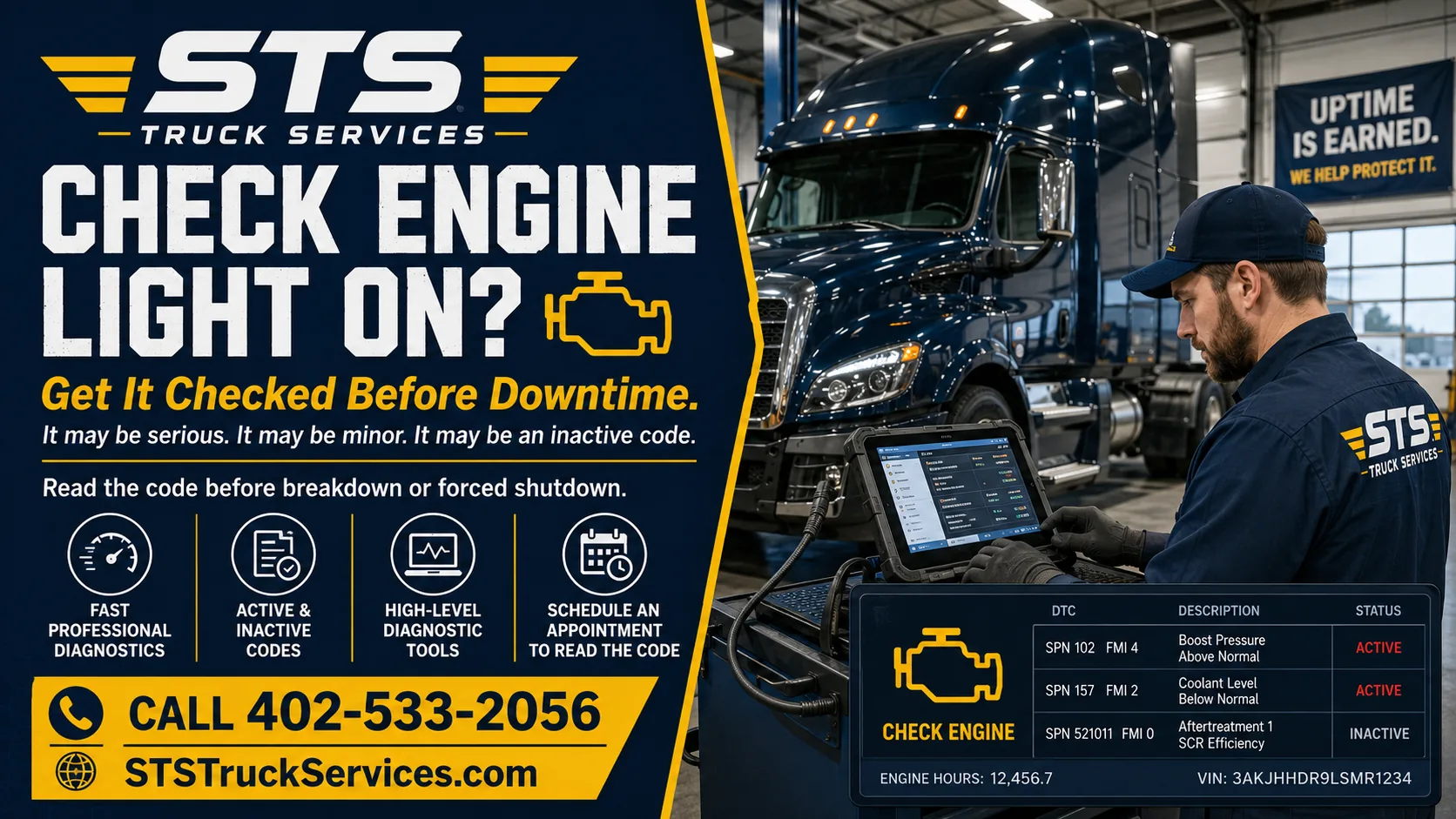
Check Engine Light On?
If your truck has a check engine light or warning light on, schedule an appointment with STS Truck Services to have the code read by professional technicians using high-level diagnostic tools.
Check Engine Light Diagnostics FAQs
Should I ignore a check engine light if the truck still runs fine?
No. A heavy-duty truck may still run while a warning light points to an active fault, inactive code history, sensor problem, emissions issue, or condition that may lead to derate or shutdown.
What is the difference between an active and inactive fault code?
An active code reflects a condition currently being detected. An inactive code means the condition may not be active at that moment, but the fault history can still explain intermittent issues or previous operating conditions.
Does clearing the code fix the truck?
No. Clearing a code only removes the warning from the dash. If the underlying condition remains, the light can return and the issue may become more serious.
Can a check engine light lead to derate?
Yes. Some aftertreatment, DEF, engine sensor, cooling, communication, or protection-related faults can progress into reduced power, derate, or forced shutdown.
Where does STS provide heavy-duty truck diagnostics?
STS Truck Services provides diagnostics for fleets and owner-operators near Blair, Omaha, Fremont, Council Bluffs, Missouri Valley, the I-29 corridor, the I-80 corridor, eastern Nebraska, and western Iowa.