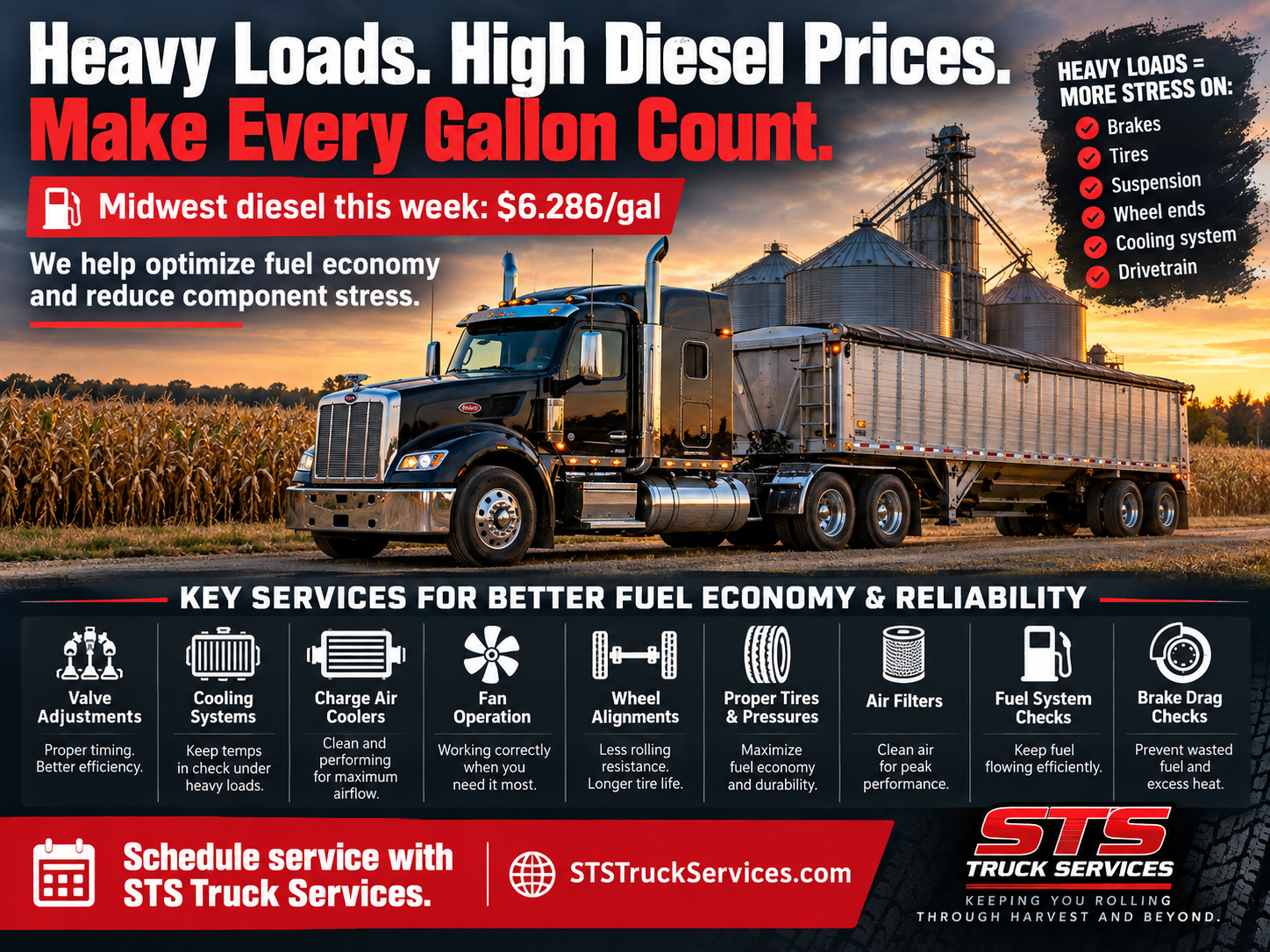
Diesel fuel is expensive, harvest loads are heavy, and trucks are working hard.
For Nebraska farms, grain haulers, livestock haulers, and commercial fleets, this season brings a difficult combination: high operating costs, extra weight, long days, and more stress on equipment.
This week, the Midwest on-highway diesel price is $6.286 per gallon, according to the U.S. Energy Information Administration. At that price, wasted fuel is not just annoying. It is expensive.
Nebraska has also issued temporary harvest-related relief for qualifying agricultural transportation. Vehicles transporting seasonally produced products and livestock may operate up to 25% over legal gross and axle group weight limits without purchasing additional permits or paying associated fees. The state has also provided dyed diesel relief for certain agricultural transportation situations.
Current-source check: The $6.286 Midwest diesel figure is the U.S. EIA average for October 5, 2026. Nebraska’s September 24 executive orders provide the agricultural weight-limit and diesel relief described here.
That relief may help farmers and haulers move product during a stressful season.
But it does not change one mechanical reality:
More Weight Makes the Truck Work Harder
When a truck is running heavy, every system is under more load.
- The engine works harder.
- The cooling system works harder.
- The brakes work harder.
- The suspension works harder.
- The tires run hotter.
- The wheel ends carry more stress.
- The drivetrain sees more strain.
The truck burns more fuel.
At STS Truck Services in Blair, Nebraska, we help fleets, farms, owner-operators, grain haulers, and commercial vehicle owners keep trucks operating safely, reliably, and efficiently.
A well-maintained truck cannot eliminate the cost of diesel or the stress of heavy loads, but it can help reduce wasted fuel, identify problems early, and protect major components before a small issue becomes downtime.
Heavy Loads Increase Operating Costs
Every extra pound moved down the road requires energy. When a truck is loaded heavier than normal, the engine must produce more power, the brakes must absorb more force, and the tires and suspension must carry more weight.
That added demand can show up as:
- Lower fuel economy
- Higher operating temperature
- More brake wear
- More tire heat
- Increased tire wear
- Extra suspension stress
- More wheel-end load
- Drivetrain strain
- More stress on cooling system components
- Increased risk of roadside downtime
During harvest, trucks are often running long hours, hauling heavy, operating in dust, dealing with field approaches, rural roads, elevator lines, stop-and-go driving, and changing weather conditions.
That is exactly when maintenance matters.
High Diesel Prices Make Small Efficiency Problems Expensive
When diesel fuel is over $6 per gallon, small fuel economy losses add up fast.
A truck that is slightly out of adjustment, fighting alignment problems, running low tire pressure, leaking boost, dragging brakes, or operating with poor fan control may still get the job done.
But it may be burning more fuel than necessary every mile.
A small efficiency problem becomes expensive when multiplied by:
- Long harvest days
- Heavy loads
- Multiple trips
- Several trucks
- High diesel prices
- Extra idle time
- Stop-and-go hauling
That is why fuel economy maintenance is not just about saving a few dollars at the pump.
It is about protecting the whole operation.
Common Problems That Hurt Fuel Economy
A truck does not have to be broken down to be costing you money.
Many fuel economy problems are caused by systems that are still working, but not working as well as they should.
At STS Truck Services, we often look for issues such as:
- Incorrect valve adjustment
- Dirty or restricted air filters
- Charge air cooler leaks
- Boost leaks
- Cooling system problems
- Fan clutch problems
- Fan running more than needed
- Poor tire pressure
- Uneven tire wear
- Alignment problems
- Brake drag
- Air system leaks
- Aftertreatment or regen issues
- Fault codes affecting performance
- Fuel system concerns
- Wheel-end issues
- Suspension problems
- Drivetrain concerns
Any one of these can make a truck work harder than necessary.
Several of them together can burn a lot of money.
Valve Adjustments Can Help the Engine Work Efficiently
A proper valve adjustment helps the engine breathe and operate as designed.
When valve lash is out of specification, the engine may not perform as efficiently. Depending on the engine and condition, poor adjustment can contribute to reduced power, rough operation, poor combustion, reduced efficiency, or extra strain on other systems.
For trucks running heavy, engine efficiency matters.
STS Truck Services can inspect maintenance history and help determine whether a valve adjustment should be considered as part of your fuel economy and reliability plan.
This is especially important for trucks that have high mileage, long service intervals, or unknown maintenance history.
Cooling System Problems Waste Fuel and Risk Downtime
Heavy loads create heat.
If the cooling system is not working properly, the truck may run hotter than it should. That can lead to poor performance, driver complaints, overheating risk, and extra stress on expensive components.
A cooling system inspection may include:
- Coolant level
- Coolant condition
- Radiator condition
- Charge air cooler condition
- Radiator cap
- Hoses and clamps
- Water pump leaks
- Fan clutch operation
- Fan blades
- Visible coolant leaks
- Airflow concerns
- Debris or restriction
A cooling system issue during harvest can turn into downtime quickly.
Keeping the cooling system in good shape helps the truck handle heavy work more reliably.
Charge Air Cooler and Boost Leaks Can Cost Power and Fuel
A charge air cooler leak or boost leak can make the engine work harder.
When the intake system cannot hold proper boost pressure, the truck may lose power, burn more fuel, smoke more, run hotter, or create aftertreatment issues. The driver may notice poor pulling power, slow acceleration, or the truck feeling lazy under load.
Common areas to inspect include:
- Charge air cooler
- Charge air piping
- Boots and clamps
- Intake connections
- Turbo-related plumbing
- Leaks under load
- Air restriction
A small boost leak may not stop the truck today, but it can hurt performance and fuel economy every mile.
During heavy hauling, that matters.
Fan Operation Matters More Than Many Owners Realize
Engine fans are necessary, but they take power to operate.
If a fan clutch is locked on, cycling incorrectly, or running when it does not need to, the truck can waste fuel and lose usable power. On the other hand, if the fan is not working properly when needed, the truck may overheat or struggle under heavy load.
Fan system concerns may include:
- Fan clutch operation
- Electrical control issues
- Air control issues
- Temperature sensor concerns
- Fan blade condition
- Cooling system airflow
- Wiring or valve problems
A fan that operates correctly helps balance cooling performance and fuel efficiency.
STS Truck Services can inspect fan operation as part of a broader performance and fuel economy review.
Tires and Tire Pressure Are Fuel Economy Items
Tires are one of the easiest places to lose fuel economy.
Low tire pressure increases rolling resistance. Uneven tire pressure can create poor handling, extra heat, irregular wear, and more stress on tires and wheel ends.
When trucks are running heavy, tire condition matters even more.
A tire inspection may include:
- Tire pressure
- Tread depth
- Uneven wear
- Sidewall damage
- Valve stems
- Dual matching
- Cupping or feathering
- Alignment-related wear
- Load-related wear
- Wheel condition
- Lug nut concerns
Proper tire pressure helps reduce rolling resistance, protect tire life, and improve safety.
At today’s diesel prices, tire pressure is not a small detail. It is a fuel economy issue.
Alignment Problems Waste Fuel and Wear Tires
A truck that is fighting the road is wasting energy.
Poor alignment can increase rolling resistance, create uneven tire wear, cause driver fatigue, and reduce fuel economy. It can also make the truck feel like it pulls, wanders, or does not track straight.
Alignment-related concerns may include:
- Steer axle alignment
- Drive axle alignment
- Trailer tracking
- Suspension wear
- Steering component wear
- Uneven tire wear patterns
- Worn bushings
- Loose components
- Bent or damaged parts
A proper alignment can help protect tires, improve handling, and reduce wasted energy.
If a truck is hauling heavy and running long miles, alignment should not be ignored.
Brake Drag Can Burn Fuel and Destroy Components
Dragging brakes are a serious fuel economy and safety issue.
If a brake is not fully releasing, the truck is working against itself. That creates heat, wastes fuel, wears brake components, damages drums or rotors, and can create tire and wheel-end concerns.
Brake drag may be caused by:
- Brake adjustment issues
- Slack adjuster problems
- Brake chamber problems
- Air valve issues
- Contaminated components
- Sticking calipers
- Air system problems
- Foundation brake wear
- Trailer brake issues
The truck may still move down the road, but it is burning extra fuel and building heat the whole time.
STS Truck Services can inspect truck and trailer brakes to help identify drag, wear, leaks, and adjustment concerns.
Air Leaks Make the Truck Work Harder
Air leaks can affect brakes, suspension, and overall reliability.
A leaking air system can cause the compressor to work more often, slow air recovery, create DOT concerns, and add stress to other components.
Common air leak areas include:
- Air lines
- Fittings
- Glad hands
- Brake chambers
- Valves
- Air tanks
- Air bags
- Trailer air systems
- Air dryer components
An air leak may seem small, but if the compressor is constantly working to keep up, the system is not operating efficiently.
Finding and fixing air leaks supports safety, reliability, and efficiency.
Aftertreatment and Regen Problems Can Hurt Fuel Economy
A truck with aftertreatment or emissions problems may use more fuel, regen more often, run poorly, or eventually derate.
Common concerns may include:
- Frequent regens
- Failed regens
- DEF system faults
- DPF restriction
- NOx sensor issues
- Temperature sensor faults
- SCR efficiency codes
- Exhaust leaks
- Wiring or sensor problems
- Check engine lights
- Derate warnings
When trucks are working heavy, aftertreatment systems are already under demand.
Ignoring warning lights or emissions issues can become expensive fast.
STS Truck Services can help diagnose aftertreatment and emissions concerns before they create downtime.
Wheel Ends and Suspension Carry the Load
Operating heavy puts more stress on wheel ends, suspension parts, bushings, shocks, springs, torque rods, air bags, and U-bolts.
When these systems are worn, they can contribute to tire wear, poor handling, extra vibration, and unexpected breakdowns.
A heavy-load inspection may include:
- Wheel seals
- Hub oil levels
- Wheel bearing concerns
- Suspension bushings
- Torque rods
- U-bolts
- Shocks
- Leaf springs
- Air bags
- Alignment-related wear
- Frame and mounting concerns
Heavy loads do not forgive weak components.
Finding worn parts before they fail helps reduce downtime and protects other systems.
Diagnostics Help Find Hidden Efficiency Problems
Not every fuel economy problem is visible during a walkaround.
A truck may have active or inactive fault codes, sensor problems, aftertreatment issues, engine performance concerns, or electrical faults that affect how it runs.
Diagnostic checks may help identify:
- Active fault codes
- Inactive fault codes
- Engine warning indicators
- DEF warnings
- Regen history
- Temperature concerns
- Sensor faults
- Derate-related concerns
- Performance issues
A truck does not have to be broken down to need diagnostics.
If it is using more fuel, running hot, feeling weak, or showing warning lights, it should be checked.
A Simple Example: Heavy Load, Small Problems, Big Fuel Cost
Imagine a grain truck running heavy during harvest.
It has low tire pressure, a dirty air filter, a small charge air leak, and a fan clutch that stays engaged more than it should.
The truck still runs.
But every mile, it is working harder than necessary.
It may be using more fuel, running hotter, pulling worse, and putting extra stress on the engine, cooling system, tires, and drivetrain.
At $6.286 per gallon diesel, that wasted fuel adds up fast.
Now imagine that same truck is inspected before the season gets fully busy. STS identifies the low tire pressure, finds the boost leak, checks the fan operation, inspects the cooling system, and helps the customer decide what needs attention.
The truck is now better prepared to work.
That is the difference between reacting to problems and managing them.
How STS Truck Services Can Help
STS Truck Services can help customers improve reliability and support better fuel economy with services such as:
- Valve adjustments
- Cooling system inspections and repairs
- Charge air cooler checks
- Boost leak testing
- Fan clutch and fan operation checks
- Tire pressure and tire inspections
- Wheel alignments
- Brake drag inspections
- Air system leak checks
- Fuel system inspections
- Air filter and intake system checks
- Aftertreatment and emissions diagnostics
- Fault code scans
- Wheel-end inspections
- Suspension and steering inspections
- Battery and charging system checks
- Preventive maintenance inspections
- DOT safety inspections
- Trailer inspections
The goal is not to promise unrealistic fuel savings.
The goal is to help the truck operate as properly and efficiently as possible for the work it is being asked to do.
Heavy Loads Require Better Maintenance
The Nebraska harvest relief may help agricultural transportation during a difficult season, but extra weight still increases mechanical stress.
If your trucks are hauling heavier loads, now is the time to pay closer attention to:
- Brakes
- Tires
- Cooling systems
- Wheel ends
- Suspension
- Steering
- Drivetrain
- Air systems
- Fan operation
- Alignment
- Diagnostics
- Aftertreatment
More load means less room for neglect.
A truck that is already marginal may not handle the extra stress well.
Heavy-Duty Truck Maintenance in Blair, Nebraska
STS Truck Services provides heavy-duty truck and trailer maintenance and repair from our shop in Blair, Nebraska.
We serve customers throughout:
- Blair, NE
- Omaha, NE
- Fremont, NE
- Council Bluffs, IA
- Missouri Valley, IA
- Washington County
- Eastern Nebraska
- Western Iowa
- Nebraska agricultural communities
- Western Iowa agricultural communities
Whether you operate a farm truck, grain truck, livestock hauler, commercial tractor, trailer, or fleet vehicle, STS Truck Services can help you prepare for heavy loads and high fuel costs.
Schedule Fuel Economy and Heavy-Load Service Today
Heavy loads and high diesel prices are tough enough.
Do not make them worse with avoidable maintenance problems.
Let STS Truck Services help inspect your truck, identify issues that may hurt fuel economy, and reduce unnecessary stress on major components.
Make every gallon count.