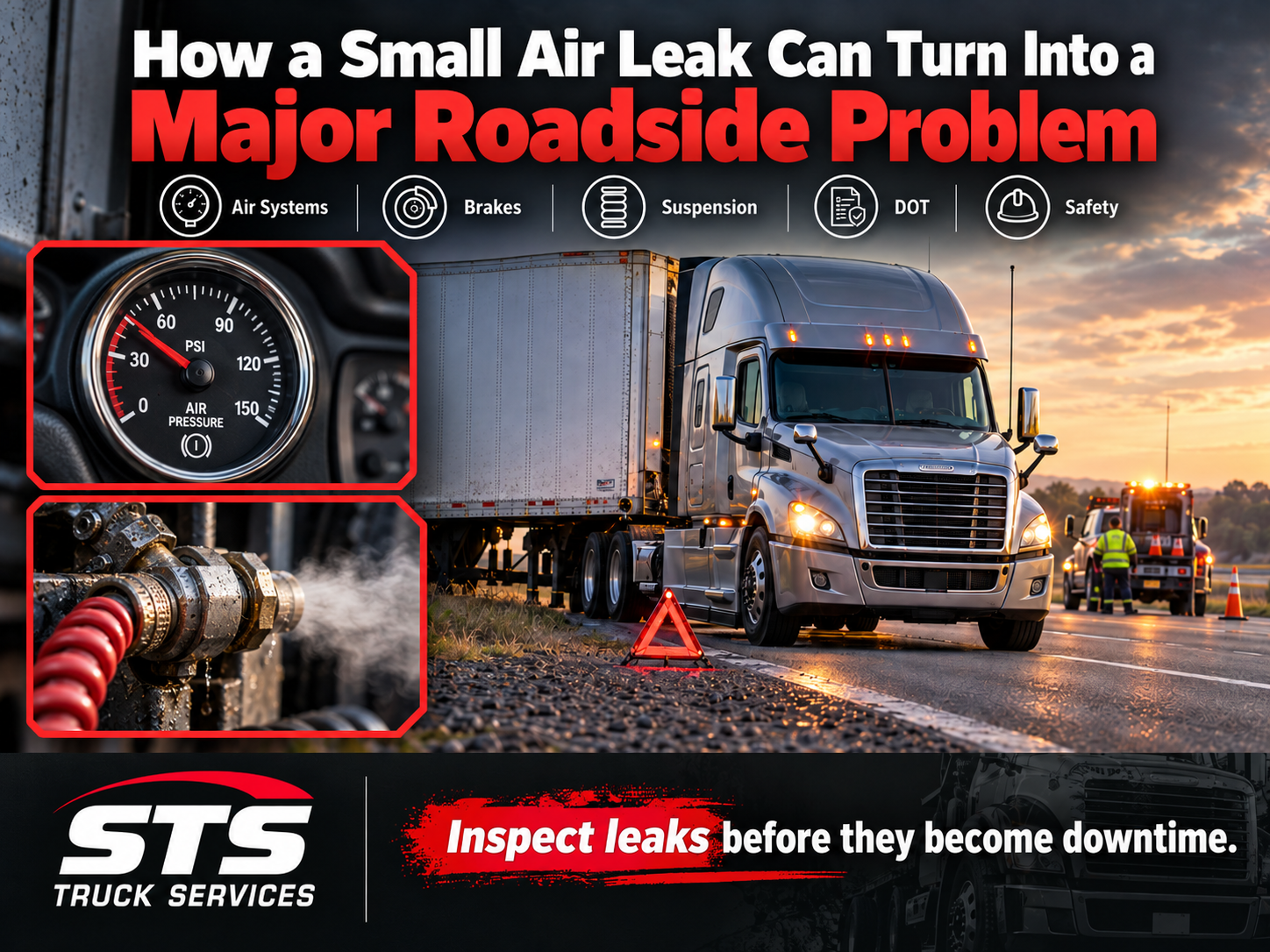
A small air leak may not seem like a big deal.
The truck still builds air.
The brakes still apply.
The suspension may still hold.
The driver may think, “I’ll get it checked later.”
But in a heavy-duty truck or trailer, air leaks are not something to ignore.
Your air system supports some of the most important systems on the vehicle, including air brakes, parking brakes, trailer brakes, air suspension, air dryers, valves, fittings, brake chambers, and other critical components. When that system is leaking, the truck is telling you something needs attention.
At STS Truck Services in Blair, Nebraska, we help fleets, owner-operators, and commercial vehicle owners inspect, diagnose, and repair air system leaks before they turn into roadside breakdowns, DOT problems, safety concerns, or costly downtime.
Inspect Leaks Before They Become Downtime
A small leak is easiest to deal with when the truck is still in your control—not when a warning light, roadside inspection, or delivery schedule decides the timing for you.
Why Truck Air Systems Matter
Heavy-duty trucks and trailers rely on compressed air for several key systems.
Most people immediately think of brakes, and that is correct. Air brakes depend on proper air pressure to operate safely and consistently. But the air system also affects other areas of the vehicle.
Air systems may support:
- Service brakes
- Parking brakes
- Trailer brakes
- Air suspension
- Air ride cab components
- Air dryers
- Brake valves
- Brake chambers
- Trailer supply lines
- Glad hands
- Air tanks
- Air fittings and lines
That means a small leak can affect more than one part of the truck.
A leaking fitting may start as a minor hiss. A rubbed air line may only leak under certain pressure or movement. A suspension air bag may slowly lose pressure overnight. A brake chamber may leak only when the service brakes are applied.
Small problems can hide until they become big problems.
The Real Enemy Is Not the Leak. It Is the Timing.
Every truck will eventually need repairs.
The problem is when the repair happens.
If an air leak is found during a planned inspection, it can often be diagnosed, scheduled, repaired, and documented. The customer stays in control.
If that same air leak turns into a low-air warning on the road, the truck may be stopped when the driver, load, and customer can least afford it.
A small air leak can become:
- A roadside breakdown
- A failed roadside inspection
- A DOT violation
- A brake system concern
- A suspension problem
- A trailer issue
- Driver downtime
- Missed delivery schedules
- Emergency repair expense
The repair itself may not be the biggest cost.
The real cost is losing control of when and where the truck goes down.
Common Signs of an Air System Problem
Drivers and fleet managers should pay attention to warning signs before the issue becomes serious.
Hissing Sounds
A steady hissing sound near a fitting, valve, air tank, brake chamber, air line, glad hand, or air bag should be inspected.
If you can hear air escaping, the system is losing pressure.
Slow Air Pressure Build-Up
If the truck takes longer than normal to build air pressure, there may be a leak, compressor issue, air dryer problem, valve concern, or another issue in the system.
Frequent Compressor Cycling
If the compressor is constantly working to recover pressure, the system may be losing air somewhere.
That extra demand can create additional wear and may point to a leak that needs to be found.
Low Air Warning
A low air warning should never be ignored.
If the low air warning activates during operation, the truck needs attention. This is a safety issue, not just an inconvenience.
Air Suspension Dropping
If the truck or trailer suspension drops after sitting, there may be an air bag leak, valve problem, line issue, or fitting leak.
Brake Application Air Loss
Some leaks only show up when the service brakes are applied. A brake chamber, valve, hose, or connection may leak under application pressure.
Trailer Air Problems
Trailer air leaks may show up at glad hands, hoses, valves, tanks, chambers, suspension bags, ABS-related valves, or damaged air lines.
Do not assume the tractor is the only problem. The trailer matters too.
Small Air Leaks Can Affect Brake Safety
Air brake systems depend on maintaining proper air pressure.
If a vehicle loses air too quickly, the system may not perform as designed. That is why drivers are trained to check air pressure loss and why inspectors take air leaks seriously.
Air leaks can affect braking by creating:
- Longer air recovery time
- Reduced system reserve
- Low air warnings
- Brake release concerns
- Parking brake concerns
- Service brake concerns
- Trailer brake concerns
- Failed leak-down tests
- DOT violations
A small leak that seems manageable in the yard can become a serious issue when the truck is loaded, operating in traffic, pulling a trailer, or dealing with hills, weather, or frequent stops.
Brake safety is not the place to gamble.
Air Leaks Can Also Affect Suspension
Air leaks are not limited to brake systems.
Many trucks and trailers use air suspension. If an air bag, height control valve, line, fitting, or leveling component leaks, the vehicle may not ride or handle correctly.
Air suspension problems can contribute to:
- Uneven ride height
- Poor ride quality
- Excessive compressor cycling
- Tire wear
- Suspension component stress
- Driver complaints
- Load handling issues
- Trailer leaning
- Damage to other components
If an air suspension problem is ignored, it can turn into a larger repair.
A suspension leak should be found and corrected before it causes additional wear.
Air Leaks Are a DOT Concern
Air leaks are not just a maintenance concern.
They can also become a DOT compliance issue.
Federal in-use inspection standards set limits for air pressure loss during air brake system checks. With the engine stopped and service brakes released, air pressure should not drop more than 2 psi in 1 minute for single vehicles or more than 3 psi in 1 minute for combination vehicles. With the system fully charged and service brakes fully applied, air pressure should not drop more than 3 psi in 1 minute for single vehicles or more than 4 psi in 1 minute for combination vehicles.
If a vehicle loses air faster than allowed, it needs attention.
A truck or trailer with excessive air loss may create inspection problems, downtime, and safety concerns.
The better strategy is simple:
Find the leak before an inspector or roadside failure finds it for you.
DOT-Style Air Brake Leak Test Procedure for Drivers
Drivers should follow company policy, CDL training, and the vehicle manufacturer’s instructions. This general leak test mirrors the pressure-loss limits used in federal inspection standards and can help identify air loss before the vehicle ends up with a roadside problem.
1. Park Safely
Park on level ground in a safe location. Set the parking brake, put the transmission in neutral, and chock the wheels if required by company policy, site conditions, or safety procedures.
2. Build Full Air Pressure
Start the engine and allow the air pressure to build to governor cut-out. This is commonly around 120–140 psi, depending on the vehicle.
3. Shut Off the Engine
Shut the engine off. Turn the key back on so the air pressure gauges and warning devices are powered, but keep the engine off.
4. Release the Brakes for the Static Leak Test
Release the parking brakes. On a combination vehicle, release both tractor and trailer brakes.
Do not press the brake pedal during this part of the test.
5. Watch the Air Gauges for 1 Minute
With the brakes released and the engine off, watch the air pressure gauges for one full minute.
Air pressure should not drop more than:
If air loss exceeds those limits, the system needs inspection.
- Single vehicle: 2 psi in 1 minute
- Combination vehicle: 3 psi in 1 minute
6. Perform the Applied Brake Leak Test
Press and hold the service brake pedal firmly. The air pressure will drop at first. Let the pressure stabilize, then continue holding firm pressure for one full minute.
With the service brakes fully applied, air pressure should not drop more than:
If air loss exceeds those limits, the vehicle should be inspected before operation.
- Single vehicle: 3 psi in 1 minute
- Combination vehicle: 4 psi in 1 minute
7. Listen for Leaks
If it is safe to do so, listen around the vehicle for hissing or escaping air. Common leak points include:
- Air lines
- Glad hands
- Brake chambers
- Air tanks
- Valves
- Air bags
- Fittings
- Trailer connections
8. Do Not Ignore a Failed Test
If the air loss exceeds limits, the vehicle builds air slowly, the low-air warning activates unexpectedly, or the driver hears an air leak, the vehicle should be inspected before it becomes a roadside failure.
A failed air leak test is not something to “watch for later.” It is the truck telling you the air system needs attention.
Common Air Leak Sources We Inspect
At STS Truck Services, our technicians can inspect and diagnose air system concerns across the truck and trailer.
Common leak sources include:
Air Lines and Tubing
Air lines can rub, crack, kink, chafe, or get damaged by road debris, vibration, age, or improper routing.
Fittings and Connections
Push-connect fittings, threaded fittings, unions, and connectors can leak over time, especially in harsh conditions.
Glad Hands
Glad hand seals and trailer connections can leak, especially when worn, dirty, cracked, or not sealing correctly.
Brake Chambers
A leaking brake chamber can be a serious safety concern and should be inspected promptly.
Air Valves
Relay valves, quick-release valves, protection valves, leveling valves, and other air valves can develop leaks or internal failures.
Air Tanks
Air tanks, drain valves, and fittings can leak. Moisture, corrosion, and age can also create problems.
Air Dryer
Air dryer issues can contribute to moisture in the system, poor performance, and related valve or line concerns.
Air Bags
Suspension air bags can crack, rub, dry rot, or leak around fittings and mounting areas.
Trailer Components
Trailer air systems include lines, tanks, valves, chambers, glad hands, ABS-related valves, suspension bags, and fittings that all need inspection.
Air leaks are not always obvious. Some only appear under application pressure, suspension movement, temperature change, or vibration.
That is why proper diagnosis matters.
Why Guessing at Air Leaks Costs More
Air leaks can be tricky.
Sometimes the loudest leak is not the only leak. Sometimes a line leaks only when the suspension moves. Sometimes a brake chamber leaks only when the brakes are applied. Sometimes the trailer is the problem, not the tractor.
Guessing can lead to wasted time and repeat repairs.
A better process includes:
- Listening for leaks
- Inspecting lines, hoses, fittings, valves, bags, tanks, chambers, and glad hands
- Checking pressure loss
- Testing with brakes released and applied
- Inspecting tractor and trailer systems
- Looking for rubbed lines and damaged routing
- Confirming the repair after the fix
At STS Truck Services, our goal is not just to stop the obvious hiss.
Our goal is to identify the issue correctly so the customer can avoid repeat downtime.
Example: The Small Leak That Became a Major Problem
Wait Until It Becomes Downtime
A driver hears a faint air leak near the trailer connection. The truck still builds air, so the driver keeps running.
Over the next few days, the leak gets worse. The compressor cycles more often. Air recovery becomes slower. The driver starts seeing pressure drop during brake applications.
Then the truck gets stopped during a roadside inspection. The air loss is beyond acceptable limits, and the vehicle is sidelined until repairs are made.
Now the customer is dealing with:
- Driver downtime
- Delayed load
- Emergency repair scheduling
- DOT concern
- Lost productivity
- A repair that could have been planned earlier
Catch It While You Still Control the Timing
The driver reports the issue. STS inspects the system, identifies the leaking glad hand seal and a rubbed trailer air line, repairs both, and confirms the air system holds pressure properly.
The difference is control.
One customer waits until the leak becomes downtime.
The other gets it fixed before it becomes a roadside problem.
Why Choose STS Truck Services for Air System Repair?
STS Truck Services helps customers keep trucks and trailers operating safely, reliably, and efficiently.
Our team can help with:
- Air leak diagnosis
- Air brake system inspection
- Trailer air leak repair
- Brake chamber concerns
- Air valve replacement
- Air line and fitting repair
- Glad hand and trailer connection issues
- Air dryer concerns
- Air suspension leaks
- Air bag replacement
- DOT inspection-related repairs
- Preventive maintenance inspections
Customers choose STS because we focus on:
- Finding the actual source of the air loss instead of guessing
- Inspecting both truck and trailer air systems when needed
- Clear communication and documented repair findings
- Confirming the system holds pressure after the repair
- Helping customers address small problems before they become expensive downtime
Heavy-Duty Air System Repair in Blair, Nebraska
STS Truck Services serves fleets, owner-operators, and commercial vehicle owners in Blair and the surrounding region, including Omaha, Fremont, Council Bluffs, Missouri Valley, eastern Nebraska, western Iowa, and the I-29/I-80 corridors.
If you hear an air leak, notice slower pressure build-up, see the suspension dropping, experience frequent compressor cycling, or have a truck or trailer fail an air-loss test, our team can inspect the system and help identify the source before it becomes a roadside problem.
The Best Time to Find an Air Leak Is Before the Truck Is Down
A faint hiss in the yard is easier to manage than a low-air warning on the highway. Catching the leak early gives you more control over the repair, the schedule, and the cost.
Hearing an Air Leak? Let STS Check It Before It Becomes Downtime.
We can inspect truck and trailer air systems, locate leaks, explain what we find, and help you make the repair before the problem chooses the timing for you.
Request Air System Service