At STS Truck Services in Blair, Nebraska, we help fleets, owner-operators, and commercial trailer owners diagnose and repair trailer ABS problems before they create bigger issues with braking performance, tire damage, downtime, or DOT compliance. Our team has the professional technicians and diagnostic tools needed to inspect, diagnose, correct, and repair trailer ABS concerns, including Lite-Check and other trailer diagnostic equipment.
Quick Takeaway for Fleet Managers
A trailer with an ABS light on may still stop during normal driving, but that does not mean the anti-lock braking system is functioning correctly when the driver needs it most. Getting the light diagnosed early can help prevent wheel lockup, flat-spotted tires, repeat driver complaints, roadside inspection issues, and unnecessary parts replacement.
What Does Trailer ABS Do?
ABS stands for anti-lock braking system. On a trailer, the ABS system is designed to help prevent wheel lockup during braking. When the driver applies the brakes, especially during a hard stop or in slick road conditions, the ABS system monitors wheel speed and helps control braking so the wheels are less likely to lock and skid.
When trailer ABS is working properly, it helps support better braking control, improved trailer stability, reduced wheel lockup, better tire contact with the road, reduced risk of flat-spotted tires, improved driver confidence, and better compliance with inspection requirements.
Trailer ABS does not replace a properly maintained air brake system. It works with the brake system to help manage wheel lockup and improve control during braking events. When the system is not working properly, the trailer may still brake, but it may not brake the way it was designed to in a panic stop, emergency stop, wet road condition, gravel lot, icy surface, or downhill braking event.
Why You Should Not Ignore a Trailer ABS Light
An ABS light is not just a dashboard annoyance or trailer lamp issue. It is a warning that the system needs to be checked. Sometimes the issue is simple. Sometimes it is more involved. Either way, the only way to know is to test and diagnose the system.
Sensor faults, contamination, gap issues, or damaged wiring can trigger ABS warnings.
Low voltage, poor grounds, and corroded connections can stop the ABS module from operating correctly.
Damaged, corroded, loose, or missing tone ring teeth can affect wheel speed readings.
Rubbed wiring, road debris, moisture, corrosion, and broken connectors are common trailer problems.
If the module will not communicate, the issue may be wiring, power, ground, module failure, or connector damage.
A poor 7-way connection can create electrical problems that look like trailer ABS faults.
Good operators do not ignore warning lights. They get them checked, document the issue, and make repair decisions based on diagnosis instead of guesswork.
Trailer ABS Problems Can Affect Braking Performance
The purpose of trailer ABS is to help prevent wheel lockup. When the system is not working, the trailer may be more likely to lock wheels during braking. That can reduce control, increase instability, and create unsafe braking behavior, especially in rain, snow, gravel, icy lots, steep grades, or emergency-stop situations.
A trailer with a failed ABS system may still stop during normal braking, but that does not mean the system is safe to ignore. The problem may show up when the driver needs the system most. That is why a warning light deserves a real inspection, not a quick reset and a hope that it stays off.
Operators may notice repeat ABS warning lights, wheel lockup, trailer skidding, pulling or instability during braking, driver complaints, less confidence in slippery conditions, braking concerns during inspections, or tire vibration after a hard stop.
Worn or Failed ABS Can Damage Tires
One of the most expensive side effects of trailer ABS problems is tire damage. When trailer wheels lock during braking, tires can slide instead of rolling. That can quickly create flat-spotted tires, irregular tire wear, accelerated tire wear, vibration complaints, road noise, tire replacement costs, and downtime for tire service.
A set of trailer tires costs a lot more than diagnosing an ABS fault early. If an ABS issue is ignored and the wheels lock during a hard stop, the trailer can come back with tire damage that did not need to happen. The repair cost may no longer be just an ABS sensor, wiring repair, or connector issue. It may also include tires, brake inspection, downtime, and another shop visit.
Smart maintenance protects more than one system.
Early trailer ABS diagnostics can protect the braking system, the tire budget, the driver, the load, the schedule, and the fleet’s compliance record.
Can Trailer ABS Fault Codes Tell You What Is Wrong?
Modern trailer ABS systems can store diagnostic fault information that helps technicians identify the direction of the problem. A code may point toward a wheel speed sensor, an open circuit, a short, a power supply issue, a ground concern, a communication problem, or an internal module issue.
But a fault code is not the same thing as a completed diagnosis. A code may tell the technician where to begin, but testing is still needed to confirm the root cause. A sensor fault, for example, could be caused by the sensor itself, damaged wiring, excessive sensor gap, corrosion, a tone ring issue, wheel-end movement, or a connector problem.
That is why STS Truck Services focuses on testing the system instead of simply replacing parts. A proper diagnostic process helps avoid wasted parts, repeat repairs, and the frustrating situation where the trailer leaves with the same warning light problem it came in with.
Trailer ABS Systems We Commonly Diagnose
Commercial trailers may be equipped with different ABS systems and components depending on the trailer age, axle configuration, manufacturer, and service history. STS Truck Services can help inspect and diagnose many common trailer ABS concerns, including systems and components associated with major commercial trailer braking and ABS brands.
The brand name matters, but the process matters even more. We want to verify power, ground, communication, lamp function, wheel speed sensor readings, wiring integrity, connector condition, and related brake or wheel-end concerns before recommending the repair.
Professional Trailer ABS Diagnostics with Lite-Check
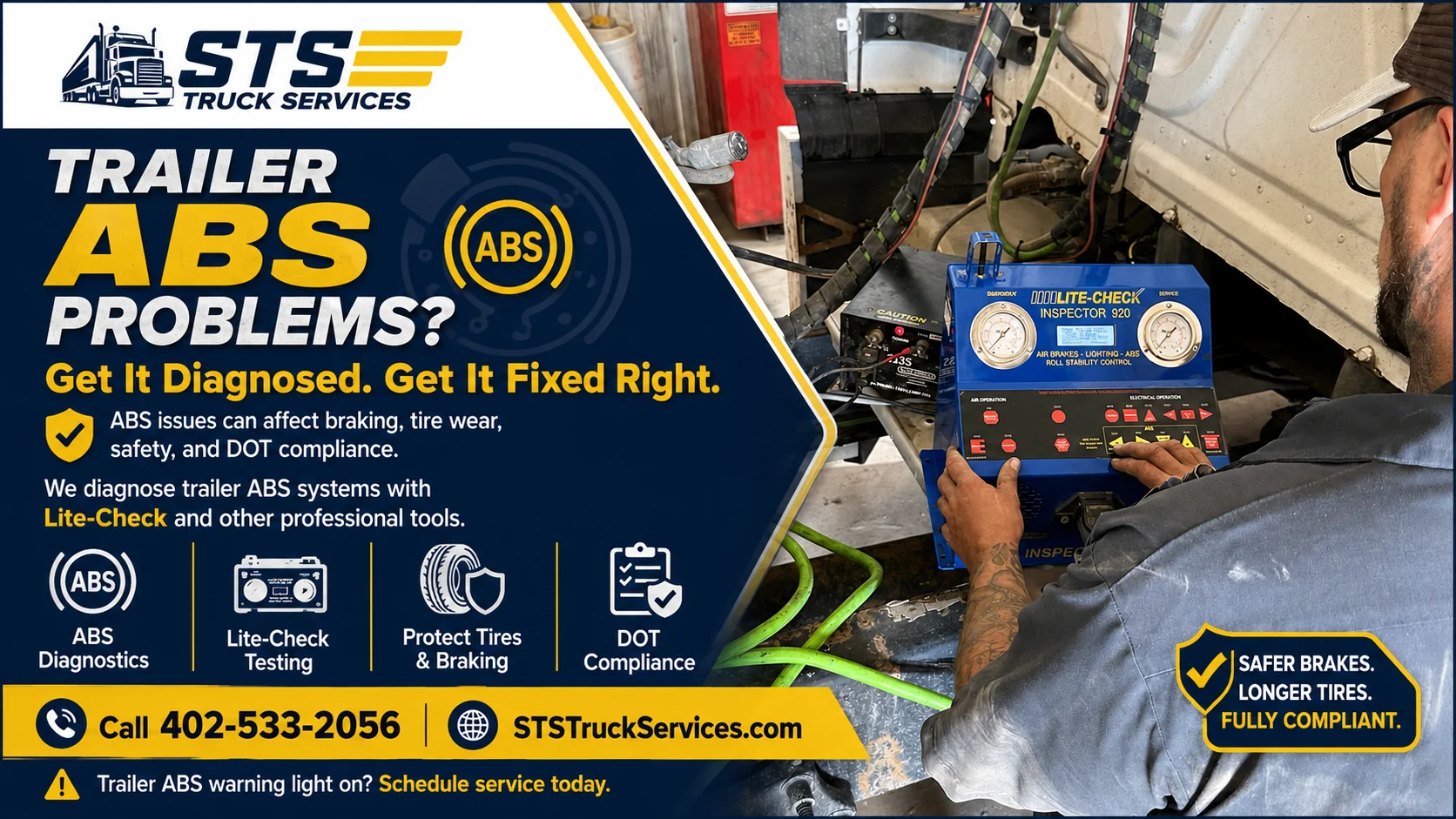
Trailer ABS work requires the right knowledge and the right equipment. At STS Truck Services, our technicians use professional diagnostic tools, including Lite-Check, to help test trailer systems and identify ABS-related issues.
Using tools like Lite-Check and other trailer diagnostic equipment helps us inspect and test trailer electrical circuits, ABS communication, ABS warning lamp function, sensor faults, power and ground issues, trailer lights, wiring problems, air brake system operation, roll stability control-related systems when equipped, and related trailer electrical and braking concerns.
This allows us to move beyond guessing and get closer to the real cause of the problem. Trailer ABS problems are often electrical or communication related, and without proper test equipment, it is easy to waste time replacing parts that do not solve the issue.
Why Lite-Check Testing Matters
The Lite-Check system helps technicians test trailer systems more efficiently and accurately. For trailer ABS concerns, that means professional equipment can help verify communication, check lamp operation, evaluate electrical function, and support proper diagnosis before parts are replaced.
What We Check During a Trailer ABS Inspection
When a trailer comes in with an ABS concern, our technicians may inspect and test several areas depending on the complaint, the system condition, and what the initial testing shows.
ABS Warning Light Operation
The ABS malfunction lamp needs to operate correctly. If the lamp is on, stays on, fails to illuminate during the proper check, or does not behave correctly, the system needs diagnosis.
Power and Ground
ABS modules need proper power and ground. Low voltage, damaged wiring, corrosion, moisture, loose terminals, or poor connections can create faults and communication problems.
Communication with the ABS ECU
If the ABS ECU will not communicate, the issue may be power, ground, wiring, connector damage, module failure, a trailer pigtail problem, or a tool/access issue.
Wheel Speed Sensors
Wheel speed sensors monitor wheel rotation. Sensor faults, damaged sensors, excessive gap, contamination, corrosion, broken retainers, or wiring damage can trigger ABS problems.
Tone Rings
Tone rings must be intact and properly positioned. Damage, corrosion, looseness, or missing teeth can affect sensor readings and cause repeat ABS concerns.
Harnesses and Connectors
Trailer wiring lives in a harsh environment. Vibration, road debris, corrosion, moisture, rubbing, and repairs from previous service events can damage ABS wiring and connectors.
Wheel-End Conditions
A wheel-end issue can affect sensor gap, tone ring position, or system performance. ABS diagnostics may reveal a need to inspect wheel-end components more closely.
Air Brake and Valve Operation
ABS interacts with the braking system. Depending on the complaint, brake valves, air supply, chambers, slack adjusters, hoses, and related components may need review.
Trailer ABS Issues Are a DOT Compliance Concern
Trailer ABS is also a compliance issue. Federal regulations include ABS and ABS malfunction indicator lamp requirements for many commercial trailers. That means a trailer ABS light problem is not something to hide or ignore. It can be found during roadside inspections, annual inspections, or maintenance reviews and may create compliance problems for your operation.
Even when an ABS light may not automatically place a vehicle out of service by itself, it is still a violation that should be corrected. For a professional fleet, “not out of service” is not the same as “acceptable to ignore.”
Ignoring the light also creates documentation risk. If a driver reports an ABS issue and the fleet continues to operate the trailer without a plan, the problem can become more than a repair concern. It can become a preventable maintenance story.
Example: How Trailer ABS Diagnostics Can Save a Fleet Money
Here is a simple example. A trailer comes in with the ABS light on. The trailer is still usable, and the brakes seem to work during normal driving, so the issue is ignored.
- A week later, the driver makes a hard stop and one or more trailer wheels lock up.
- The trailer now has flat-spotted tires and the driver reports vibration.
- The trailer needs tire replacement, brake inspection, and still needs the original ABS issue diagnosed.
- What could have been a planned diagnostic appointment becomes tire expense, additional labor, more downtime, driver complaints, possible DOT issues, and a trailer out of service longer than expected.
Now compare that to getting the ABS light checked early. If the issue is a sensor, wiring problem, power supply issue, ground concern, or connector fault, it may be diagnosed and repaired before it damages tires or creates a larger problem. That is smart maintenance.
Common Trailer ABS Repairs
Every trailer is different, but common trailer ABS-related repairs may include wheel speed sensor replacement, sensor adjustment or cleaning, wiring harness repair, connector cleaning or replacement, ground repair, power supply repair, ABS ECU/module diagnosis, tone ring inspection or correction, ABS lamp repair, trailer pigtail or 7-way connection repair, air brake valve diagnosis, and wheel-end repair when related to sensor gap or tone ring concerns.
The important thing is to diagnose before replacing parts. Replacing parts without confirming the cause can waste money and leave the same warning light on.
Why Trailer ABS Diagnostics Should Be Part of Preventive Maintenance
Trailer ABS should not only be checked after a roadside inspection or driver complaint. It should be included in a smart preventive maintenance and trailer inspection process.
During regular maintenance, operators should pay attention to ABS light operation, trailer electrical connection condition, harness routing and rub points, corrosion at connectors, damaged or missing wiring protection, sensor wiring near wheel ends, brake and wheel-end condition, and driver reports of skidding, vibration, or tire flat spots.
Catching an ABS issue during a planned inspection is much better than finding it after a roadside inspection or after tires are already damaged.
When Should You Schedule Trailer ABS Diagnostics?
Schedule service when the trailer ABS light stays on, the light does not come on during the proper check, the ABS lamp blinks repeatedly, the trailer will not communicate with diagnostic equipment, the driver reports skidding or lockup, tires show flat spots after braking, there are repeat wiring or light issues, the trailer recently had wheel-end work, or an inspection found an ABS-related concern.
It is also smart to ask for ABS checks during annual DOT inspections, trailer PMs, pre-trip issue follow-ups, used trailer evaluations, and post-repair verification after brake or wheel-end work.
Why Choose STS Truck Services for Trailer ABS Diagnostics?
STS Truck Services helps customers keep trucks and trailers operating safely, reliably, and efficiently. Customers choose us for trailer ABS work because we offer professional technicians, Lite-Check and other trailer diagnostic equipment, heavy-duty truck and trailer repair experience, electrical diagnostic capability, brake system knowledge, practical repair recommendations, clear communication, a preventive maintenance mindset, and a focus on safety, reliability, and efficiency.
We understand that trailers are working equipment. When one goes down, it affects your schedule, drivers, customers, and revenue. Our goal is to help you identify the issue, correct it properly, and keep your equipment moving.
Trailer ABS Diagnostics in Blair, Nebraska
If you are looking for trailer ABS diagnostics near Blair, Nebraska, STS Truck Services can help. We serve fleets, owner-operators, and businesses operating in and around Blair, Omaha, Fremont, Missouri Valley, Council Bluffs, Washington County, eastern Nebraska, western Iowa, and the I-29 and I-80 corridors.
Whether your trailer ABS light is on, your ABS lamp is not working, your trailer will not communicate, or your driver reports braking concerns, we can help diagnose the problem and recommend the correct repair.
Related STS Services
Trailer ABS Diagnostics FAQs
Why is my trailer ABS light staying on?
The light may stay on because of a wheel speed sensor fault, wiring damage, poor ground, low voltage, ABS ECU communication issue, bad connector, tone ring problem, or lamp circuit issue. Testing is needed to confirm the cause.
Can I drive with the trailer ABS light on?
The trailer may still brake during normal driving, but the anti-lock braking system may not work correctly during wheel lockup conditions. It should be diagnosed instead of ignored.
What causes trailer ABS communication faults?
Communication faults can come from power supply issues, poor grounds, damaged harnesses, corroded connectors, module problems, trailer pigtail concerns, or wiring damage between the tractor and trailer.
Does an ABS light fail a DOT inspection?
An ABS malfunction lamp problem can create a DOT compliance issue. Even if it is not automatically an out-of-service condition by itself, it is still something that should be corrected.
Can trailer ABS problems damage tires?
Yes. If wheels lock during braking because ABS is not working correctly, tires may slide instead of roll. That can create flat spots, vibration, irregular wear, and unnecessary tire replacement costs.
Do ABS fault codes always identify the bad part?
No. Fault codes help point technicians in the right direction, but the root cause still needs to be tested. A sensor code may be caused by the sensor, wiring, connector condition, tone ring damage, or wheel-end movement.
What trailer ABS brands can STS diagnose?
STS Truck Services can help diagnose many common commercial trailer ABS concerns, including systems and components associated with Bendix, WABCO, Meritor, Haldex, ABS ECUs, wheel speed sensors, wiring, and trailer communication circuits.
How do I schedule trailer ABS service?
Call STS Truck Services at 402-533-2056 or use the online repair request link to schedule trailer ABS diagnostics in Blair, Nebraska.
Schedule Trailer ABS Service Today
A trailer ABS light is not something to ignore. It can affect braking performance, tire life, driver confidence, and DOT compliance. If your trailer ABS light is on or your trailer ABS system is not working correctly, schedule service with STS Truck Services.